

How Pioneering Companies Innovate with Human-Centricity
At the core of modern business transformation lies a powerful combination: cutting-edge technology integrated with human-centric design. This fusion drives digital efficiency and enriches it with the crucial element of human experience. In the following sections, we explore how pioneering companies place this synergy at the forefront of their innovation and transformation. These trailblazers understand that true progress enhances, rather than overshadows, the human aspects of business.
 Key Takeaways
- Businesses thrive by blending technology with human design. Leaders like Starbucks show success through personalized, human-centric digital services.
- Visionary leaders align their company’s actions with its goals. Whole Foods’ Jason Buechel integrates ethical practices with business innovation, setting industry standards.
- Progressive organizations like Infosys foster continuous learning. They pivot strategies towards agile, customer-centric development, ensuring industry leadership.
- Successful companies align departmental efforts with the corporate vision. Apple’s iPhone success stems from meticulous cross-departmental collaboration and a unified vision.
- Influential leaders, like Xerox’s Ursula Burns, use storytelling to guide change. Airbnb’s narrative design has reshaped the travel industry by fostering a sense of belonging.
 The Changing Landscape of Business and the Human Experience
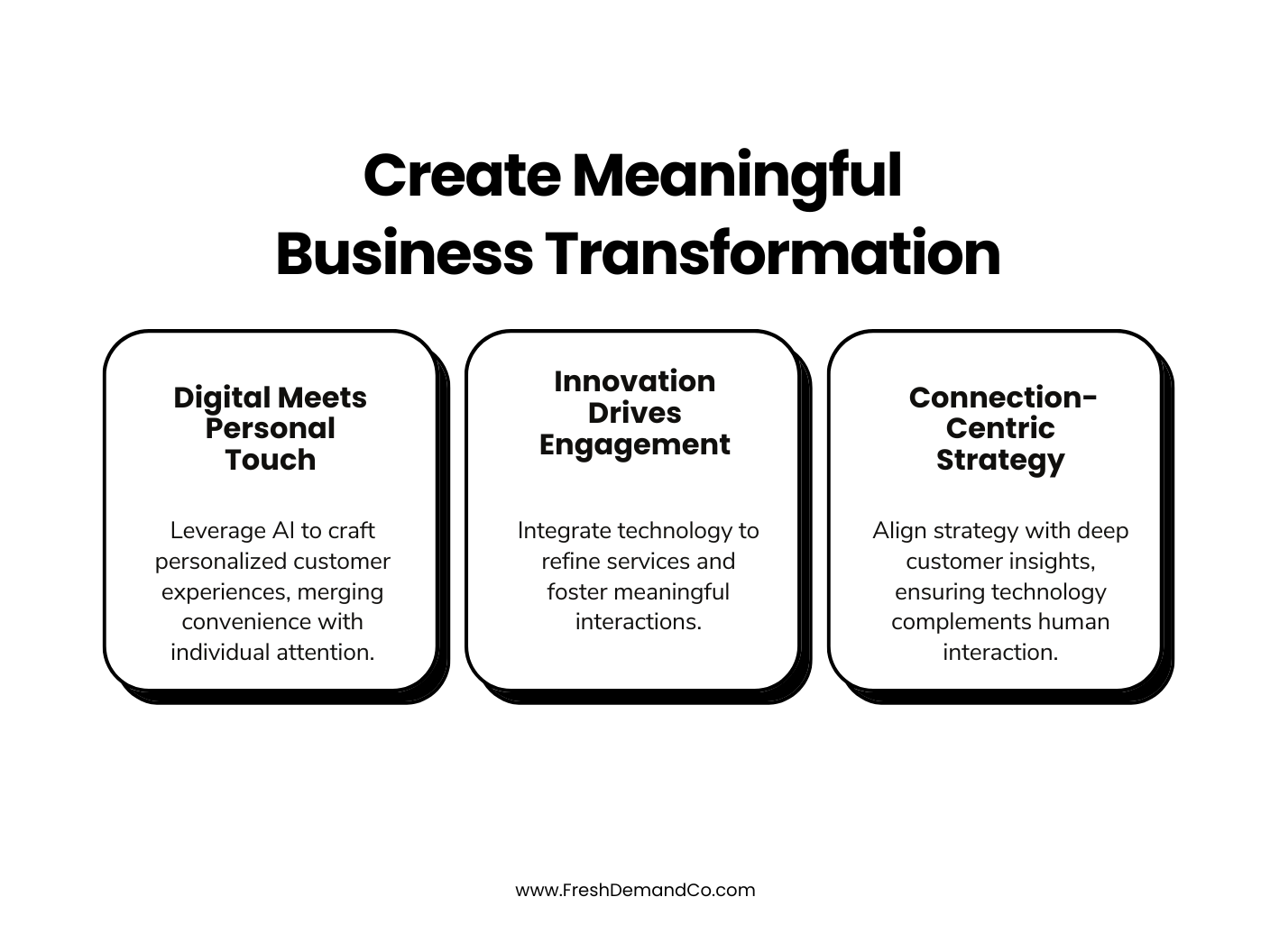
Given the rapid advancement of digital innovation, many businesses are experiencing a transformative period of merging cutting-edge technology with human centricity. This blend of sophisticated digital tools and personal connection has reshaped what it means to succeed. After all, establishing meaningful human interactions is the foundation of customer loyalty and brand uniqueness. As technology evolves, organizations will need to balance the power of technology with the nuances of human interaction while creating experiences that are as smooth technologically as they are rich in emotional engagement.
Empathy and Innovation at Starbucks
Artificial intelligence and the ongoing push for data will continue to reshape industries. Regardless of your growth goals, fundamental business transformation’s core remains within the human experience.
Starbucks adeptly employs AI to enhance rather than replace the human element in its journey toward digital transformation. This integration allows personalized customer experiences through tailored mobile offerings and recommendations, ensuring every digital and in-person interaction feels unique and authentic. Implementing AI goes beyond streamlining processes; it enriches the customer journey, making mobile ordering more convenient and personalized.
In parallel, machine learning algorithms are utilized to refine store operations, from efficient scheduling of maintenance tasks to effective inventory management. This strategic use of technology empowers Starbucks’ staff to concentrate on their core mission: creating meaningful human connections. Whether it’s a solitary moment of reflection or a shared experience, Starbucks’ staff can focus on crafting those pivotal interactions. By centering on the importance of genuine engagement, Starbucks upholds its position as an innovator. It cements its reputation as a space where technology meets and enhances the warmth of human connection.
Strategies and the Bedrock of Success
Corporations like Starbucks understand that digital and personal interactions must enhance each other, not compete. For these companies, true innovation lies in deep customer relationships. The most advanced businesses maintain a core focus on human connections.
 Visionary Leadership: The Nexus of Business Transformation
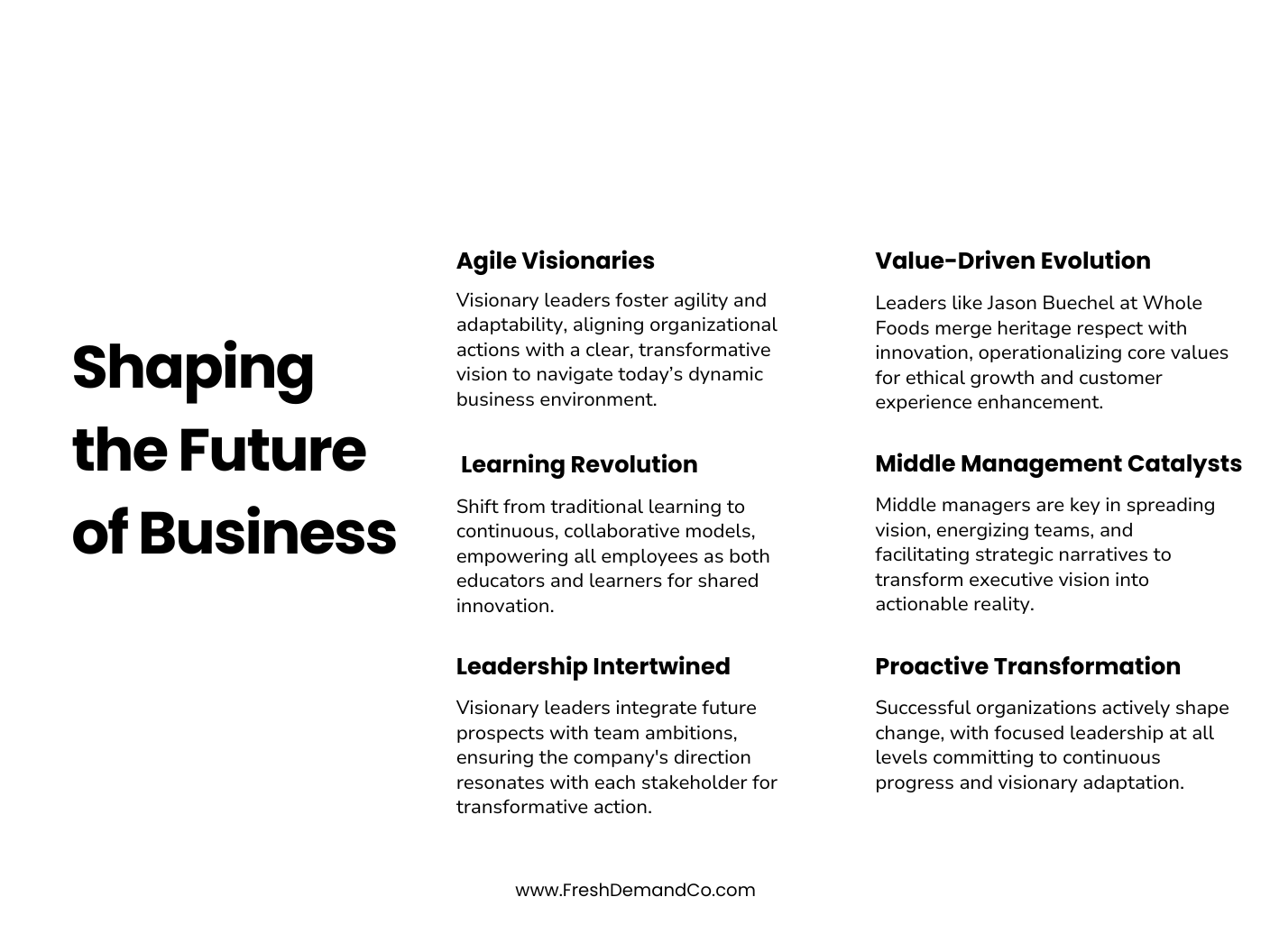
Given the rate of organizational change and transformation, fostering agility, adaptability, and alignment must evolve from mere buzzwords to vital imperatives. And the success of any business transformation is defined by the gap between vision and action, underscoring the symbiotic relationship between visionary leadership and collective commitment. This delicate interplay sets the foundation for success in today’s increasingly complex ecosystem.
Reinventing Organizational Learning
The digitized epoch has also ushered in transformative shifts in how organizations learn. Traditional top-down methods have given way to continuous, collaborative engagement models. Within this paradigm, everyone, irrespective of hierarchy, wears two hats: teacher and learner.
Leaders must transition from rigid learning structures to cultures enriched by shared insights and unified innovation objectives. Consider General Electric’s Crotonville campus, once emblematic of centralized learning but now a testament to the need for change. Managers must evolve into mentors and coaches who prioritize performance enhancement through ongoing guidance and support.
In the vanguard of business transformation, Learning and Development (L&D) teams are pivotal, not merely keeping pace with but also forecasting and sculpting the future of work. By synchronizing intimately with business strategies, L&D ensures the workforce is primed for the demands of a digital, knowledge-intensive economy. This evolution acknowledges that human capital is critical to a competitive edge, requiring innovative and agile learning and development (L&D). The L&D strategy should reflect the markets and technologies targeted, making learning a continuous, integral part of growth and strategic planning.
Visionary Leadership: More Than Just Vision
Visionary leadership transcends the act of looking ahead. It involves weaving the future into the tapestry of each team member’s ambitions and motivations. The critical challenge of business transformation is crafting a tangible vision and actionable strategy that resonates with every stakeholder.
Jason Buechel’s leadership at Whole Foods deftly intertwines respect for the brand’s heritage with a push for innovation and growth. He operationalizes core values—quality, ethical consumerism, sustainability—into every aspect of the business. Initiatives such as sustainable sourcing and advanced retail technology enhance the customer experience, aligning with ethical practices. Under Buechel, Whole Foods evolves through a principled yet flexible approach, empowering employees to become active proponents of the company’s values and mission.
Furthermore, the role of middle management in disseminating and enacting this vision cannot be overstated. Far from being mere intermediaries, middle managers are instrumental in galvanizing their teams, conveying strategic narratives, and removing barriers to smooth operations. For instance, Google’s Project Oxygen delineated eight core attributes of management effectiveness derived from empirical analysis. Google embeds these qualities into its development programs, allowing the executive vision to infuse all levels of its culture.
Embracing Change with Focused Leadership
Organizations poised for success blend visionary leadership with a unified, company-wide dedication to progress. Such organizations are not passive observers of change but active participants in molding the business terrain. Whole Foods Market is a testament to visionary leadership’s profound impact.
 Organizational Congruence and Visionary Alignment
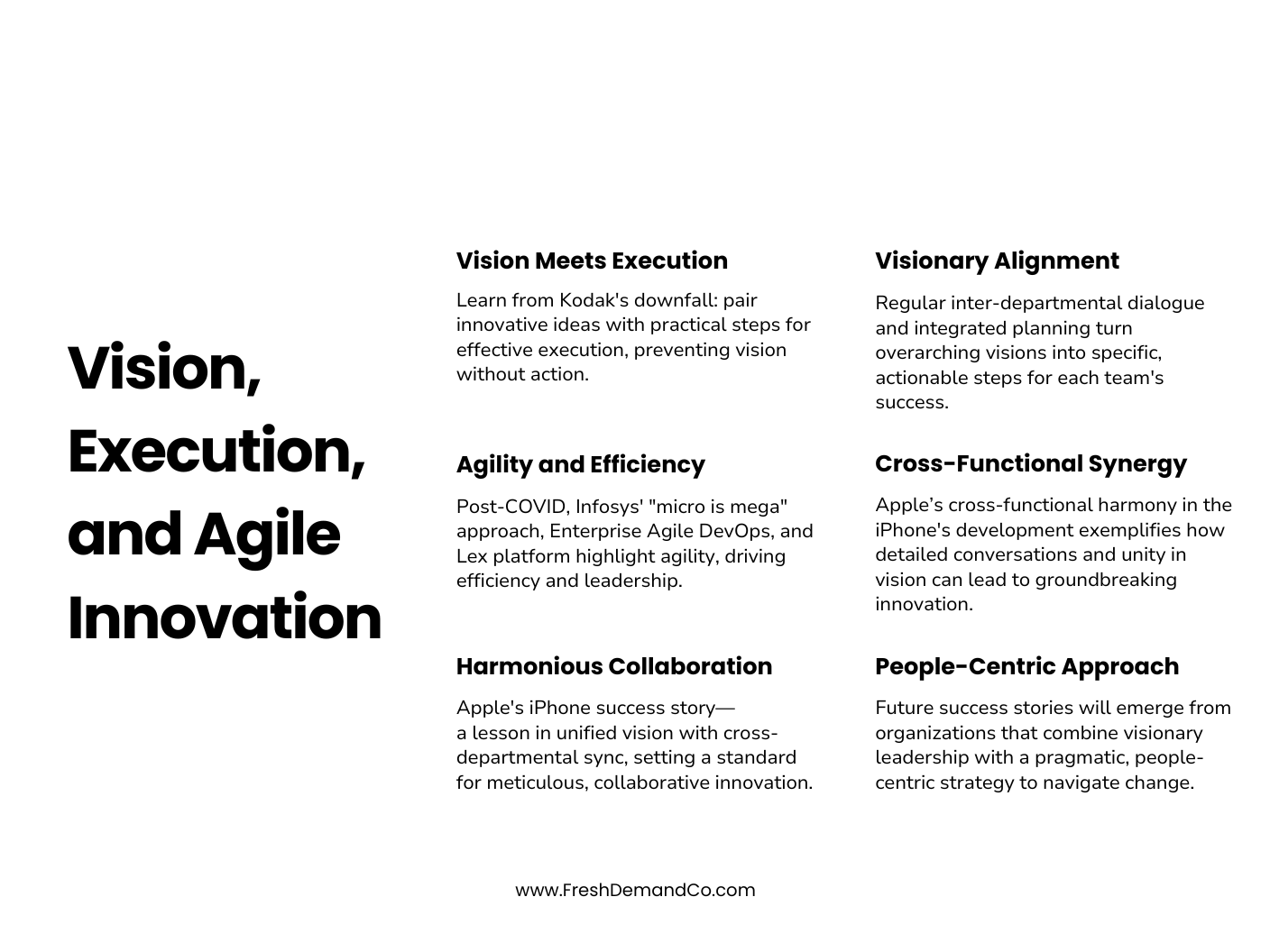
Kodak’s decline highlights the risks of innovative ideas without effective execution. The lesson is clear: practical steps to realize a vision are necessary for even the most pioneering innovations. In the face of such lessons, your business transformation must anchor visionary thought with actionable strategies to avoid a similar fate.
Infosys thrives post-COVID by prioritizing agility and incremental innovation with its “micro is the new mega” philosophy. By introducing Enterprise Agile DevOps capabilities, Infosys has positioned itself at the vanguard of customer-centric and secure value creation. The strategic pivot, evident in the Syngenta partnership, showcases significant efficiency gains and cost reductions.
Furthermore, initiatives such as the Lex digital learning platform underscore Infosys’s commitment to continuous learning and adaptability — core principles of an organization where visionary alignment drives sustained advancement and industry leadership.
Mastering Vision Alignment in Today’s Enterprises
Today’s corporate journey is more about orchestrating a symphony than navigating a straightforward path. Despite its distinct role, every department must align with the larger company mission. This orchestral harmony demands a clear vision and a deep dive into the specifics of each department’s role. Regular inter-departmental conversations, integrated planning, and uniform metrics are essential. Still, the true magic happens when each team trusts and breaks down the vision into actionable steps.
Apple’s storied success with the iPhone epitomizes the power of unified vision and cross-functional synergy. The triumph was not just the innovation of a product but the synchronization of every Apple sector: hardware melding with software, design interlocking with marketing. The success of Apple is the outcome of meticulous cross-departmental conversations and a culture where leaders are deeply invested three levels down. Managers at Apple prepare for meetings with the expectation of deep dives into specifics—a testament to a corporate ethos emphasizing unity and thoroughness as essential to decision-making and overall success.
This granular understanding and constant feedback sharpen the company vision, fostering resilience and a collective drive that catapults the company ahead.
Pioneering Tomorrow’s Success Stories
A people-centric approach is paramount in an era where technology evolves quickly. Success belongs to those who fuse clear-sighted leadership with pragmatic action, navigate change with agility, and weave their strategic vision into the dynamic fabric of the marketplace through decisive, targeted initiatives.
 Strategic Adaptation & Collaborative Innovation
Strategic dialogues are more than just conversations; they’re the crucible in which ideas are shaped into strategic actions. Consider how IBM, once synonymous with mainframe computers, reinvented itself. By recognizing the unsustainable nature of relying solely on hardware in a software-centric world, IBM transformed into a cloud and cognitive solutions powerhouse. This strategic shift was not just a change in services but a complete overhaul in culture and operations, illustrating the power of strategic dialogues to reinvent an enterprise’s core identity.
Tencent’s WeChat exemplifies strategic dexterity, evolving from a mere messaging service into an all-encompassing ecosystem that merges social media, payments, and many other services. This seamless integration arose from strategic internal dialogues and astute partnerships, fostering synergies across diverse functionalities. By uniting various service sectors under a single, user-centric platform, WeChat has created a ubiquitous digital experience, demonstrating the power of transcending departmental confines and stitching together disparate business units into a coherent, competitive force in the digital market.
Realizing Human Potential in the Technological Renaissance
The relationship between technology and the workforce is a given, yet an organization’s ability to integrate the two is often complicated and wrought with unforeseen challenges.
AT&T’s digital reinvention showcases the potency of this human and tech integration. The telecom giant invested in upgrading its network to 5G and reskilling its workforce, understanding that the success of its technology depended on its people being equipped to harness it. AT&T implemented extensive training programs, acknowledging that the human element—creativity, decision-making, and emotional intelligence—cannot be replicated by machines. AT&T positions itself at the forefront of the digital revolution by fostering a culture where technology amplifies human capability.
These examples encapsulate the essence of the modern enterprise journey: it combines the strategic ingenuity seen in IBM’s pivot, the ecosystem mastery exemplified by WeChat, and the tech-human harmonization demonstrated by AT&T. These are not isolated instances but patterns that dictate the path forward for contemporary businesses.
Charting the Path Forward
Business success hinges on combining human-focused strategies with digital innovation. Future leaders will foresee trends and blend them with transformative tech and vision. They will excel in preempting shifts, fostering ongoing engagement, and leveraging technology to amplify human capabilities. These organizations set themselves apart by not merely riding the tides of change but by being the architects of the market’s currents.
 Storytelling and Design in Transformation
Transformational storytelling is vital in business, blending an organization’s history with its future vision. Our innate connection to stories enables them to unite and guide us, a quality crucial during times of change. Clear, inspiring stories are as fundamental as the strategies they support. They should provide clarity, spark enthusiasm, and secure collective commitment to the company’s direction.
At Xerox, Ursula Burns harnessed the power of narrative when the company stood at the crossroads of change. Amidst market skepticism and internal uncertainty, she wove a compelling story of reinvention.
Burns shifted Xerox from a photocopying giant to a multifaceted service and technology enterprise. She merged Xerox’s legacy with a vision for digital expansion, maintaining its essence while embracing IT services.
She openly shared the company’s struggles, enhancing her leadership’s authenticity and bolstering trust among employees, investors, and customers. Burns consistently communicated Xerox’s new direction, aligning all stakeholders toward a common goal.
Manifesto and Design: The Airbnb Experience
A strong story can capture the imagination, but how it’s presented can determine whether it captivates the heart. How a narrative is designed — from the visual aesthetic to the user experience — can amplify its reach and impact.
Airbnb’s transformation of the travel industry is rooted in its business model and narrative of “belonging anywhere.” The company wove its philosophy of warmth and inclusivity into all business facets. User experience and interface design exemplified this approach. The “Live There” campaign in 2016 was about creating immersive experiences that fostered connection and understanding. Airbnb meticulously designed its narrative, transforming the user’s stay into a larger story about community and shared experiences. This strategy changed Airbnb from a service into a global movement, redefining how people perceive travel and each other.
The Pinnacle of Transformational Leadership
Looking ahead, we envision organizations where digital tools spark creativity and innovation. Business transformation will stem from an acute awareness and connection to human needs.
The blueprint for business evolution now demands a narrative enriched by learning, adaptability, empathy, and engaging all stakeholders. The most successful leaders will place human centricity at the heart of their innovation strategy.