
The Tools & Tactics You Need to Grow
Sustaining business growth hinges on developing stronger client relationships. This is especially true when upselling and cross-selling. In an increasingly digital sales environment – with Gartner projecting 80% of B2B sales to occur digitally by 2025 – adapting to buyer preferences for a seller-free experience is vital. This shift in how buyers search for vendors will require a focus on data and personalization.
Key Takeaways
- Predictive analytics can help you identify the time to engage customers.
- Personalization, including dynamic pricing, tailors the customer experience, meets individual needs, and boosts satisfaction.
- Integrating unified dashboards with feature flagging significantly improves user interaction, which is essential for effective upselling and cross-selling.
- Gamified incentives, such as milestone rewards and loyalty tiers, effectively motivate users, making upselling and cross-selling more interactive and appealing.
What is Cross-selling and Upselling
Cross-selling and upselling are two strategic approaches used in SaaS technology to increase revenue growth by maximizing customer value. Cross-selling involves offering complementary products or services that enhance the customer’s experience with your company’s offerings. This approach aims to increase the utility and value customers derive from your solutions, which leads to higher revenue and customer retention. The goal is to make your tools integral to your clients’ workflow.
On the other hand, upselling encourages customers to upgrade to higher-tier plans, which offer greater features, capabilities, or capacity. This approach contributes directly to revenue growth by increasing the average revenue per user (ARPU) and ensuring that the customers’ evolving needs are met more effectively.

Building Your Upsell and Cross-Sell Strategy
Predictive analytics and behavior-driven triggers lay the foundation for identifying upsell and cross-sell opportunities by analyzing past customer behaviors to forecast future actions. This approach, grounded in data, allows for a precise and efficient strategy beyond mere speculation. By examining historical data, such as past purchases and engagement patterns, businesses can pinpoint the right moment for upsell or cross-sell initiatives.
To further refine this strategy, incorporating a personalized customer experience is crucial. Personalization involves tailoring offers and communications to fit customers’ unique needs and preferences based on detailed insights from their interactions and behaviors. This can significantly enhance the effectiveness of upsell and cross-sell efforts, making each offer feel relevant and valuable to the customer.
Moreover, leveraging customer feedback is vital in ensuring your strategy remains aligned with customer expectations and needs. Actively seeking and integrating feedback into your sales approach helps identify areas for improvement and foster stronger relationships. Customers feel valued and understood, making them more open to additional offers that meet their needs.
Implementing Your Strategy
- Data Collection and Analysis: Utilize analytics tools to gather and analyze user behavior, employing machine learning for predictive analytics and churn prediction. This analysis helps identify both upsell/cross-sell opportunities and potential churn risks.
- Behavior-Driven Triggers: Set up automated alerts for specific customer behaviors that indicate readiness for an upsell or risk of churn. This enables timely and targeted interventions.
- Personalized Outreach: Customize your sales and retention efforts based on the insights gained from data analysis and customer feedback. Tailor your messages and offers to reflect the customer’s history, preferences, and feedback.
- Churn Prediction and Intervention: Use churn prediction models to proactively address at-risk customers through personalized retention strategies, such as exclusive features access or special offers.
- Customer Feedback Integration: Continuously engage with customers to collect feedback, using insights to refine your product, service, and the overall customer experience.
By taking this holistic approach, businesses can create a dynamic and effective upsell and cross-sell strategy that anticipates customer needs and proactively addresses churn risks. The key is to blend data-driven insights with a deep understanding of customer preferences and feedback, fostering long-term, value-driven relationships that benefit your company and its customers. This approach ensures strength in the competitive landscape, driven by a commitment to customer satisfaction and personalized engagement.
 Personalized Offerings
A one-size-fits-all strategy often falls short of meeting customer expectations. In contrast, personalization focuses on creating tailored experiences and solutions. This approach considers individual clients’ or user groups’ specific needs, behaviors, and expectations.
Dynamic Pricing Models
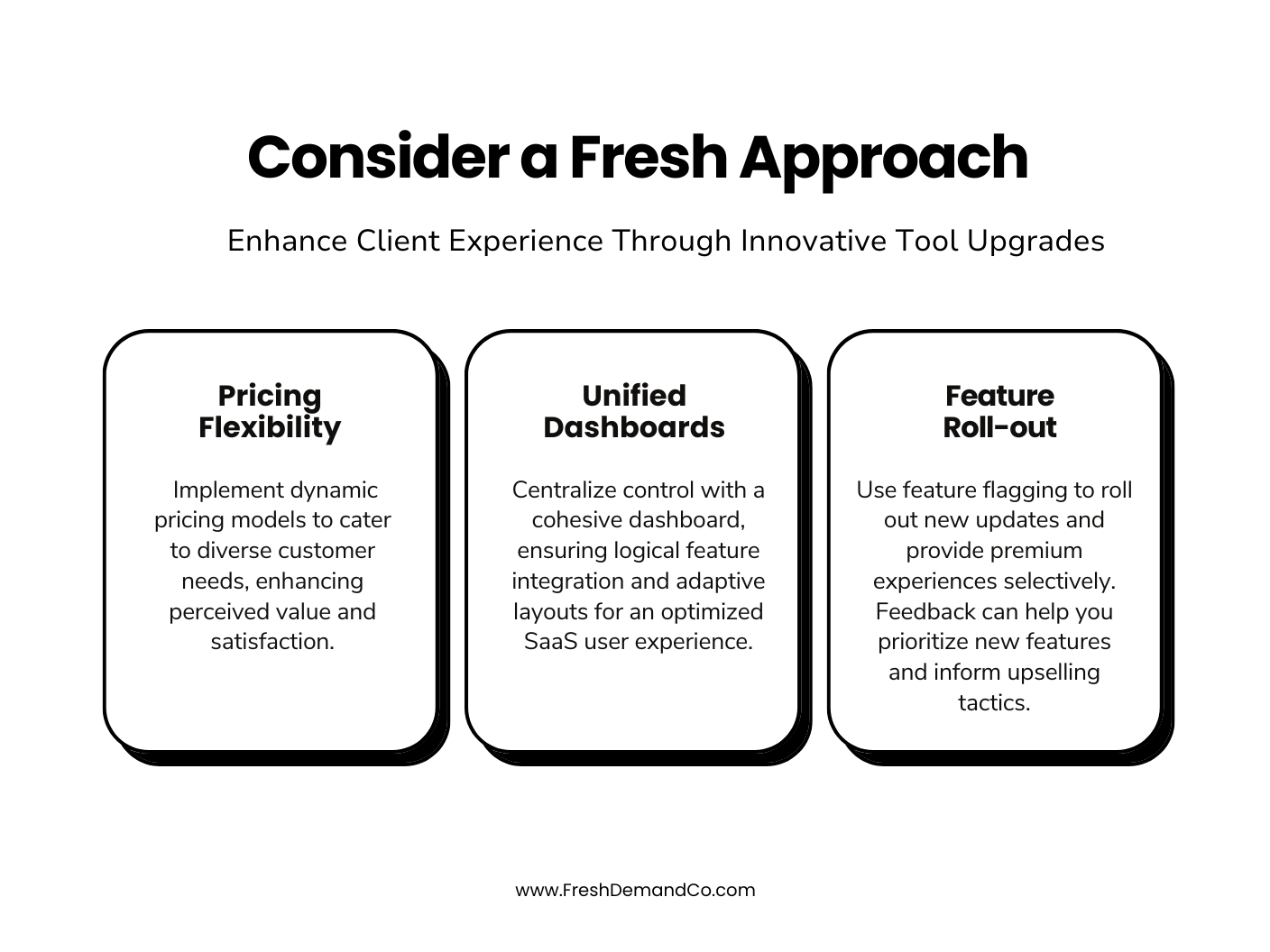
Adopting dynamic pricing models is crucial for B2B SaaS companies to cater to clients’ varied and unique needs. Dynamic pricing adjusts to customer usage and preferences, matching the businesses’ adaptability. This flexibility meets clients’ diverse requirements and enhances the service’s perceived value. Here are key ways to implement dynamic pricing models:
- Usage-Based Pricing: Utilize analytics platforms like Google Analytics or Mixpanel to monitor client usage patterns closely. For power users, consider offering discounts for new features or propose bundled packages that align with their needs.
- Behavior-Driven Pricing: Pay attention to client behavior, such as the frequency of feature interactions or the number of user logins. Tools like Heap can help you track these behaviors, which reveal insights about your client’s needs. Businesses can tailor their pricing or bundle offers to match these recurring usage patterns.
- Company Size and Needs: Tailor pricing models to fit the scale and requirements of different companies. Larger enterprises with more extensive resources may be more interested in premium features, specialized support, or advanced security options. On the other hand, startups or smaller firms often look for flexibility, scalability, and affordability. Segmenting clients with CRM tools could help develop pricing models aligned with each client’s size and specific needs.
Creating Seamless Experiences
Ensuring a natural and easy transition to new or improved features is crucial as customer needs evolve. Abrupt changes or a steep learning curve can detract from the user experience, potentially leading to buyer remorse or churn. Thus, the concept of a familiar experience, yet new, comes into play. It focuses on offering users a unified, easy-to-use interface even as your suite of tools and features expand.
Two pivotal mechanisms to ensure this smooth transition are unified dashboards and feature flagging.
Centralizing Control and Customization
- Unified Dashboards: A comprehensive dashboard acts as the command center for users to customize their SaaS experience.
- Feature Integration: Tools like Sketch or Adobe XD can help you keep layouts logical and consistent for existing users.
- Adaptive Layouts: Additionally, dashboards should change based on the features a customer has access to, expanding or contracting to display relevant tools and data, with platforms like Tableau helping to create dynamic elements.
- Guided Onboarding: Incorporating onboarding tools like WalkMe or Appcues can be invaluable for users, overlaying step-by-step guides, tooltips, and tutorials directly onto the dashboard to help them understand and utilize new features effectively.
Businesses enhance user experience by updating dashboards and gradually adding new features in a user-friendly way. This method allows for a tailored and controlled introduction of new functions.
Feature Flagging: Tailoring User Experience with Controlled Release
- Selective Rollouts: Tools like LaunchDarkly or Split.io enable businesses to turn on specific features for certain segments based on behaviors, subscription tiers, or other criteria.
- Taste of Premium: Let users try advanced features to experience added value, encouraging them to upgrade.
- Feedback Loops: Gathering user feedback through tools like UserVoice or Feedbackify is helpful as new functionalities are introduced, shaping the final version of the feature and informing broader release strategies.
Combining unified dashboards and feature flagging can improve customer experience and sales processes. This approach ensures users see the value of upgrades and can apply them to their daily workflows before investing. Interactive demos and ROI calculators are also helpful as they demonstrate product features and quantify potential benefits.
 Value-Driven Content
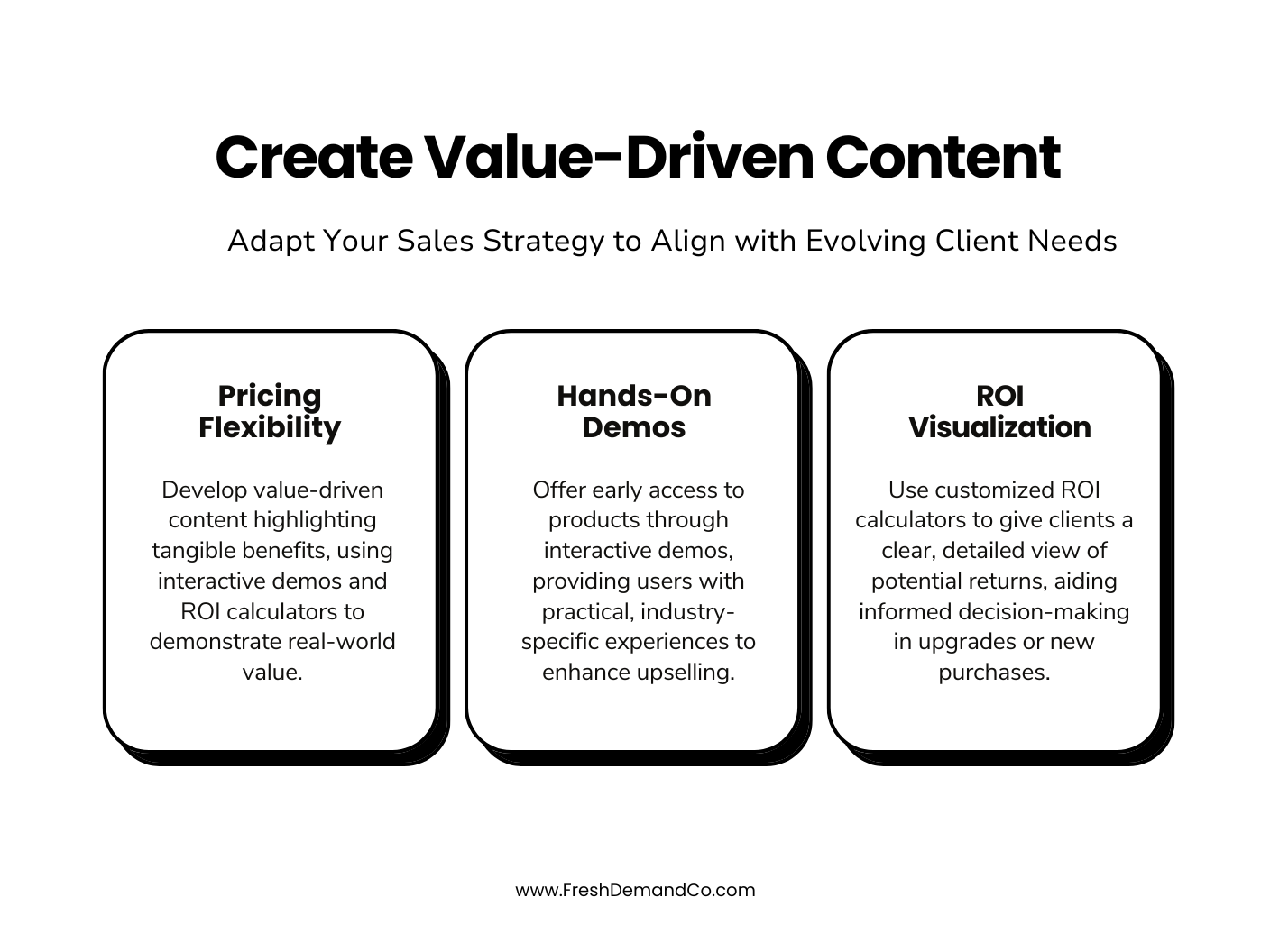
Value-driven content goes beyond standard promotional materials to deeply resonate with the potential client’s aspirations, pain points, and objectives. Rather than just informing users about a product or feature, the aim is to showcase its tangible benefits vividly. Effectively upselling and cross-selling often hinge on your ability to convey the concrete value a customer stands to gain. Two foundational techniques to emphasize this value are interactive demos and ROI calculators.
Upselling and Cross-Selling
- Special Access: Give clients early access to new products or features with interactive demos or trial periods.
- Product Tours: Develop guided tours showing new features, improved workflows, and productivity enhancements, giving users a fundamental understanding of advanced capabilities.
- Contextual Learning: Move beyond generic demonstrations by creating scenarios that align with the user’s industry or role. Employ tools like Storyline 360 or Adobe Captivate to make these demos more relevant and engaging.
- Feedback Integration: Turn interactive demos into a two-way communication channel. Embedding tools like Contentsquare allow users to share feedback and offer insights for future strategies.
Interactive demos give a hands-on view of product features and benefits, while ROI calculators quantify the financial gains of upgrades or new purchases. Additionally, these tools provide a clear numerical ROI, solidifying the upsell or cross-sell value for customers.
ROI Calculators
- Customization: Tailoring ROI calculators to reflect the unique metrics, pricing models, and value propositions of each B2B SaaS solution and customer profile is essential. Tools like Outgrow or Calconic help create these customized calculators.
- Scenario Modelling: Allowing users to adjust variables like company size, transaction volume, or projected growth helps them visualize various ROI scenarios. This feature adds an interactive dimension to the calculator, making it a more effective tool for decision-making.
- Transparent Breakdown: ROI calculators must provide a detailed breakdown of the return on investment, not just a single figure. Detailed metrics such as savings, increased revenues, and time savings help clients make informed decisions.
Gamified rewards serve as an alternative method to boost user involvement and participation.
 Gamified Incentives
Game-like mechanics in non-game environments can motivate and engage users. Within B2B SaaS, gamification can encourage users to explore upsell or cross-sell options. The gamified approach taps into the inherent human desire for achievement, competition, and rewards. Two standard techniques include milestone rewards and loyalty tiers.
Milestone Rewards
This strategy rewards users as they achieve specific usage or engagement benchmarks.
-
- Usage Tracking: Tools like Segment or Mixpanel can help SaaS companies monitor user interactions, allowing them to set meaningful and attainable milestones and rewarding users after they’ve created their tenth project or processed their hundredth transaction.
- Dynamic Achievements: Instead of static milestones, use algorithms to set personalized milestones based on a user’s usage pattern, ensuring they’re challenging yet attainable.
- Tangible Rewards: The rewards can vary from exclusive features, extended trial periods, discounts, or physical goods. Services like Tremendous can facilitate the distribution of such rewards.
Loyalty Tiers
This is a structured system where users climb ranks based on their actions, earning points or badges that can be redeemed.
-
- Tiered Ladder System: Design a clear hierarchy of levels or tiers with perks. As users climb this ladder, they unlock more valuable rewards, further incentivizing continued engagement. Platforms like Influitive can aid in creating customer advocacy.
- Diversified Actions: While points can be awarded for basic actions like tenure or frequent usage, diversifying point-earning actions—such as referrals, beta testing, or attending webinars—can increase overall engagement and exploration of the platform.
- Redemption Store: Establish a redemption portal where accumulated points can be exchanged for upsells, feature unlocks, discounts, or third-party offers. This tangible value realization further reinforces the benefits of participation.
Integrating gamified incentives significantly shifts how B2B SaaS companies engage users in upselling and cross-selling. It’s about making the experience more interactive and rewarding and fostering a community-like environment where users are motivated and recognized for their engagement. This community-oriented approach naturally leads to the concept of collaborative upselling.
 Collaborative Upselling
Collaborative upselling is a strategic approach that leverages partnerships, integrations, and community engagement to drive upselling and cross-selling opportunities. Instead of pushing products in isolation, collaborative upselling emphasizes interconnectedness and synergy between various tools, platforms, and users. Essential techniques include integrating with external platforms and community building.
Integrate with External Platforms
-
- API Integrations: Develop robust APIs facilitating easy integrations with complementary tools and platforms. Tools like Zapier or MuleSoft can aid in creating seamless integrations, allowing users to bridge functionalities between different SaaS products.
- Exclusive Feature Unlocks: Design certain product features to become fully functional or enhanced when integrated with partner platforms. For instance, an analytics tool might offer deeper insights when connected to a specific CRM, encouraging users of one to adopt the other.
- Joint Marketing Efforts: Collaborate with partner platforms on co-marketing campaigns. Webinars, co-authored content, and combined promotional offers can raise awareness and incentivize users to explore the integrated functionalities, driving upsell and cross-sell opportunities.
Community Building
-
- Dedicated Platforms: Launch platforms like forums, chat groups, or dedicated social media groups where users can congregate. Consider platforms like Discourse or Circle to facilitate the creation and management of such communities.
- User Spotlights: Regularly feature success stories of users who’ve reaped benefits from your broader SaaS offerings. Real-world testimonials can be powerful persuaders for others considering an upgrade or add-on.
- Peer Recommendations: Encourage community members to share their experiences with various features or integrations. Based on genuine use-case scenarios, peer recommendations often carry more weight than direct promotional content. Rewarding users for sharing their stories or helping others can fuel this collaborative spirit.
- Continuous Engagement: Keep the community active with regular challenges, Q&A sessions, webinars, or Ask Me Anything (AMA) sessions with product experts. The more vibrant the community, the more opportunities arise for organic discussions around upselling and cross-selling.
As you evolve your upselling and cross-selling strategies, it’s essential to consider how new platform offerings are rolled out and communicated.
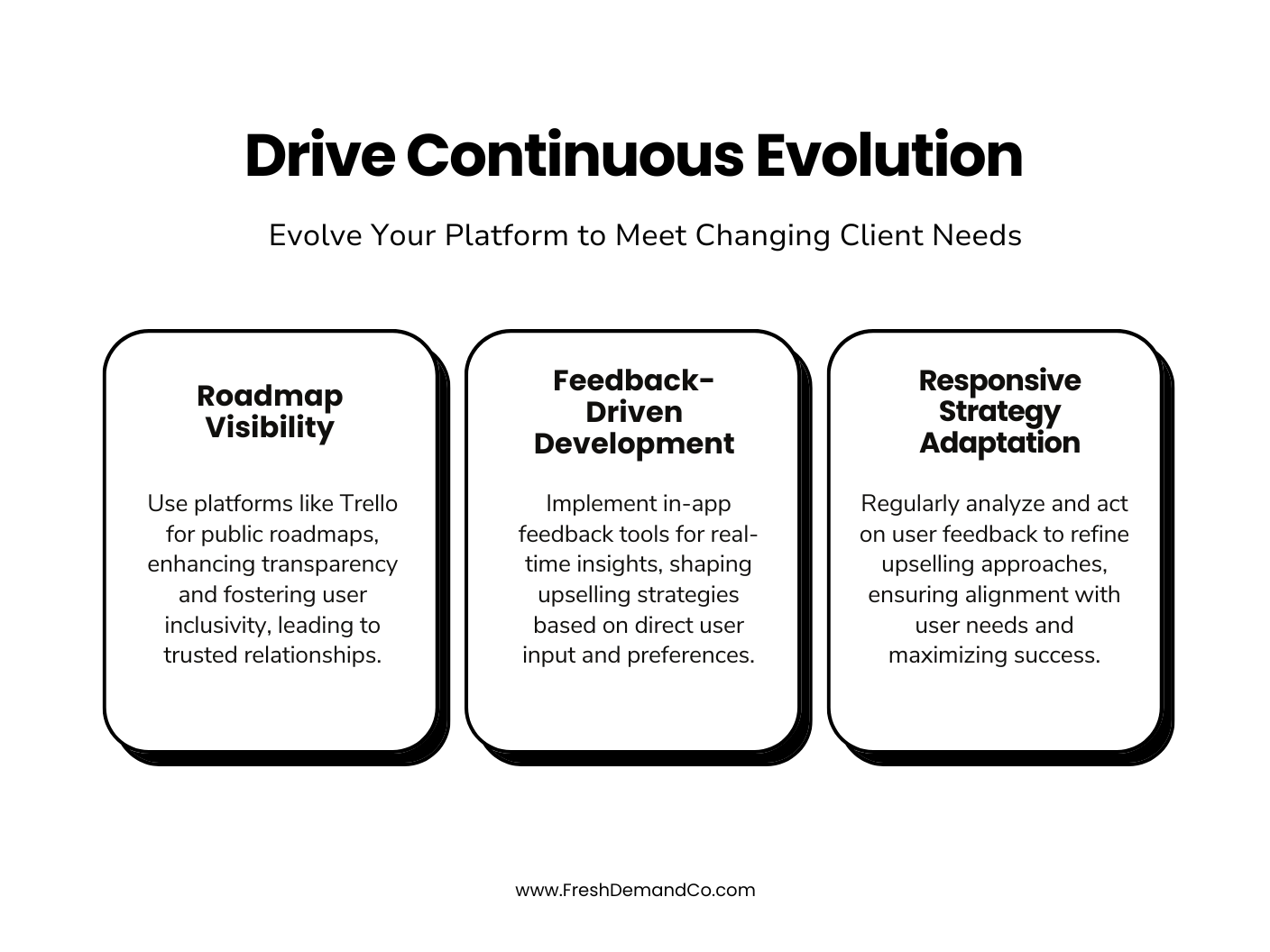 Transparent Feedback Mechanisms
Transparent feedback mechanisms are processes and tools that facilitate open communication between SaaS companies and their user base regarding product developments, features, and potential upgrades. By being transparent about their plans and openly seeking feedback, companies can nurture trust, better understand user needs, and tailor their upselling strategies accordingly.
Open Roadmaps
-
- Visibility & Transparency: Platforms like Trello or Productboard can be used to create public-facing roadmaps. This allows users to see what’s on the horizon, fostering trust and creating a sense of inclusivity. It shows that the company values input and is clear about its direction.
- Feature Voting: Allow customers to vote on proposed features or enhancements. This not only gauges interest but can also be a precursor to upselling. If a highly-voted feature becomes part of a higher-tier plan, it creates a natural upsell opportunity for those who expressed interest.
- Anticipation Building: Periodically update the roadmap and notify users of changes. Highlighting upcoming features or improvements can build anticipation, especially if they align with the needs or interests of potential upgraders.
Instant Feedback Channels
-
- In-app Feedback Tools: Integrate tools like UserVoice to allow users to voice their opinions, concerns, or suggestions directly within the application. Such instant feedback mechanisms offer insights into what users value, which can inform upselling strategies.
- Feedback-driven upselling: Analyze feedback to identify common requests or pain points. If certain features or add-ons address these needs, it presents a natural upsell pitch. “You asked, and we listened. Check out this new feature available in our premium tier!”
- Real-time Strategy Refinement: Continuous feedback allows SaaS companies to adapt their upselling strategies quickly. If a particular pitch isn’t resonating or has a substantial interest in a specific feature, strategies can be adjusted on the fly to maximize success.
- Acknowledgment and Action: It’s about collecting and acting on feedback. Regularly update users on how their feedback has shaped product decisions. This bolsters trust and underscores the value of upgrading to access newly introduced or improved features.
By implementing a transparent feedback mechanism, you can shift from a purely business-centric approach to one that values and incorporates user perspectives. This approach makes customers feel valued and heard and lays a robust foundation for upselling initiatives that align with user needs and preferences.
These strategies are not just about immediate financial gains but also about building long-term loyalty. You enhance overall customer satisfaction and engagement by aligning your company’s offerings closely with your customer’s business growth and changing requirements.
FAQs
How do predictive analytics identify the right time to engage customers for upselling or cross-selling?
Predictive analytics use historical data, machine learning algorithms, and behavioral patterns to forecast when a customer might need an upgrade or an additional product. By analyzing customer interactions, purchase history, and engagement levels, companies can predict the most opportune moments to make an offer, thus increasing the likelihood of acceptance. This could involve identifying patterns that suggest a customer is outgrowing their current plan or showing interest in features of a higher tier or complementary product.
Can you provide more examples of how gamified incentives have successfully motivated users in B2B SaaS environments?
In B2B SaaS, gamified incentives have been used to drive user engagement and product adoption. For instance, a company might implement a system where users earn points for completing onboarding tasks, referring new users, or actively using the platform to reach certain milestones. These points could then be redeemed for rewards such as premium feature access for a limited time, discounts on subscription renewals, or even company merchandise. Examples include Salesforce’s Trailhead, where users earn badges and rank by completing tutorials and challenges, enhancing product knowledge, and encouraging platform usage.
How do companies measure the effectiveness of personalized outreach and dynamic pricing in their upsell and cross-sell strategies?
The effectiveness of personalized outreach and dynamic pricing can be measured through several key performance indicators (KPIs), including conversion rates, average revenue per user (ARPU), customer lifetime value (CLV), and customer satisfaction scores. Companies can gauge the impact on sales and customer engagement by comparing these metrics before and after implementing personalized outreach and dynamic pricing strategies. Additionally, A/B testing can be used to experiment with different levels of personalization and pricing strategies to find the most effective approach.
What challenges do companies face when implementing feature flagging for controlled release, and how can they overcome them?
Implementing feature flagging can introduce challenges such as increased complexity in code management, potential performance impacts, and the need for robust infrastructure to manage feature flags at scale. To overcome these challenges, companies should adopt best practices such as maintaining a clean and well-documented codebase, using feature flag management platforms to centralize control and monitoring, and conducting thorough testing to ensure that feature toggles do not negatively impact application performance.
How do B2B SaaS companies ensure that their gamified incentives align with brand and business goals rather than just providing entertainment?
To ensure that gamified incentives align with professional and business goals, companies should design their gamification strategies with clear objectives, such as increasing product usage, enhancing feature adoption, or promoting customer loyalty. The rewards and milestones should be directly related to the platform’s value, encouraging behaviors that lead to greater productivity, efficiency, or revenue generation for the user’s business. This requires a deep understanding of the customer’s business processes and objectives, enabling the design of engaging and relevant incentives to the professional context.
What is the best way to identify and establish strategic partnerships for collaborative upselling?
Identifying and establishing strategic partnerships for collaborative upselling involves a multi-step process. Initially, companies should conduct market research to identify potential partners whose products or services complement their own. Criteria for selection include market reputation, user base compatibility, and technological synergy. After shortlisting potential partners, companies should engage in discussions to explore mutual benefits, focusing on how the partnership can enhance value for users of both platforms. Establishing such partnerships typically requires negotiations on integration specifics, co-marketing arrangements, and revenue sharing models, ensuring the collaboration benefits both parties and their customers.
What are the main challenges in managing multiple platform integrations, and how do we overcome them?
Managing multiple platform integrations presents challenges such as maintaining API compatibility, ensuring data security and privacy, and providing a unified user experience. To overcome these challenges, companies should adopt robust API management tools that facilitate easy updates and compatibility checks. Additionally, implementing strict data security protocols and ensuring compliance with relevant privacy regulations are crucial. Regularly testing the integrations in various environments helps identify and resolve user experience issues, ensuring seamless operation across different platforms.
How do you measure the impact of community engagement on upselling and cross-selling success?
To measure the impact of community engagement on upselling and cross-selling success, companies should track specific metrics such as community growth rate, engagement levels (e.g., posts, likes, comments), conversion rates from community interactions to upsell purchases, and customer lifetime value (CLV) of community members versus non-members. Analyzing these metrics over time can provide insights into how community initiatives contribute to revenue growth. Surveys and feedback from community members can also offer qualitative insights into the effectiveness of community-driven upselling strategies.
What are the best practices for implementing and managing feedback loops?
Implementing and managing effective feedback loops involves several best practices. First, integrate feedback tools that are easily accessible within the product, encouraging users to share their input effortlessly. Prioritize feedback based on its frequency and potential impact on user satisfaction and product improvement. Establish a transparent process for reviewing and acting on feedback, including timelines for implementation. Communicate to users how their feedback is being addressed, fostering a sense of involvement and appreciation. Lastly, continuously refine the feedback process based on user input and the evolving needs of the business.
How do you balance sharing a product roadmap with maintaining a competitive advantage?
Balancing transparency with maintaining competitive advantage requires a strategic approach to information sharing. Companies should be transparent about their development roadmap and feedback mechanisms to build trust and engage users. However, they should also carefully consider which details to disclose publicly, especially regarding features or strategies that could give competitors an edge. Sharing general directions and themes without divulging specific implementation details can strike the right balance. Additionally, engaging directly with users through secure channels can provide deeper insights without exposing sensitive information broadly.