


In the competitive arena of B2B SaaS, the collaboration of marketing and sales is crucial. Embracing a strategy that integrates a detailed competitor analysis, a deep understanding of buyer personas, and the targeted approach of Account-Based Marketing (ABM) becomes essential.
This guide offers a roadmap, equipping your marketing and sales units to thrive amidst continuous digital shifts.
Key Takeaways
-
- Modern ABM success is rooted in setting clear objectives, sculpting detailed buyer personas, employing data-centric tactics, and enhancing the collaboration between sales and marketing.
- For a competitive edge in ABM, source insights from platforms like search engines, events, industry reports, and user feedback to refine your marketing tactics.
- Effective ABM requires selecting prime target accounts, tailoring content, and using bespoke outreach techniques for optimal engagement.
- Continuously refine buyer personas through thorough historical study, adaptive persona modeling, and interdepartmental collaboration.
- To enhance your B2B SaaS communications, deeply understand your buyer personas. Create content tailored to each persona, refine it based on feedback, and continuously align it with evolving industry trends.
- Modern ABM success is rooted in setting clear objectives, sculpting detailed buyer personas, employing data-centric tactics, and enhancing the collaboration between sales and marketing.
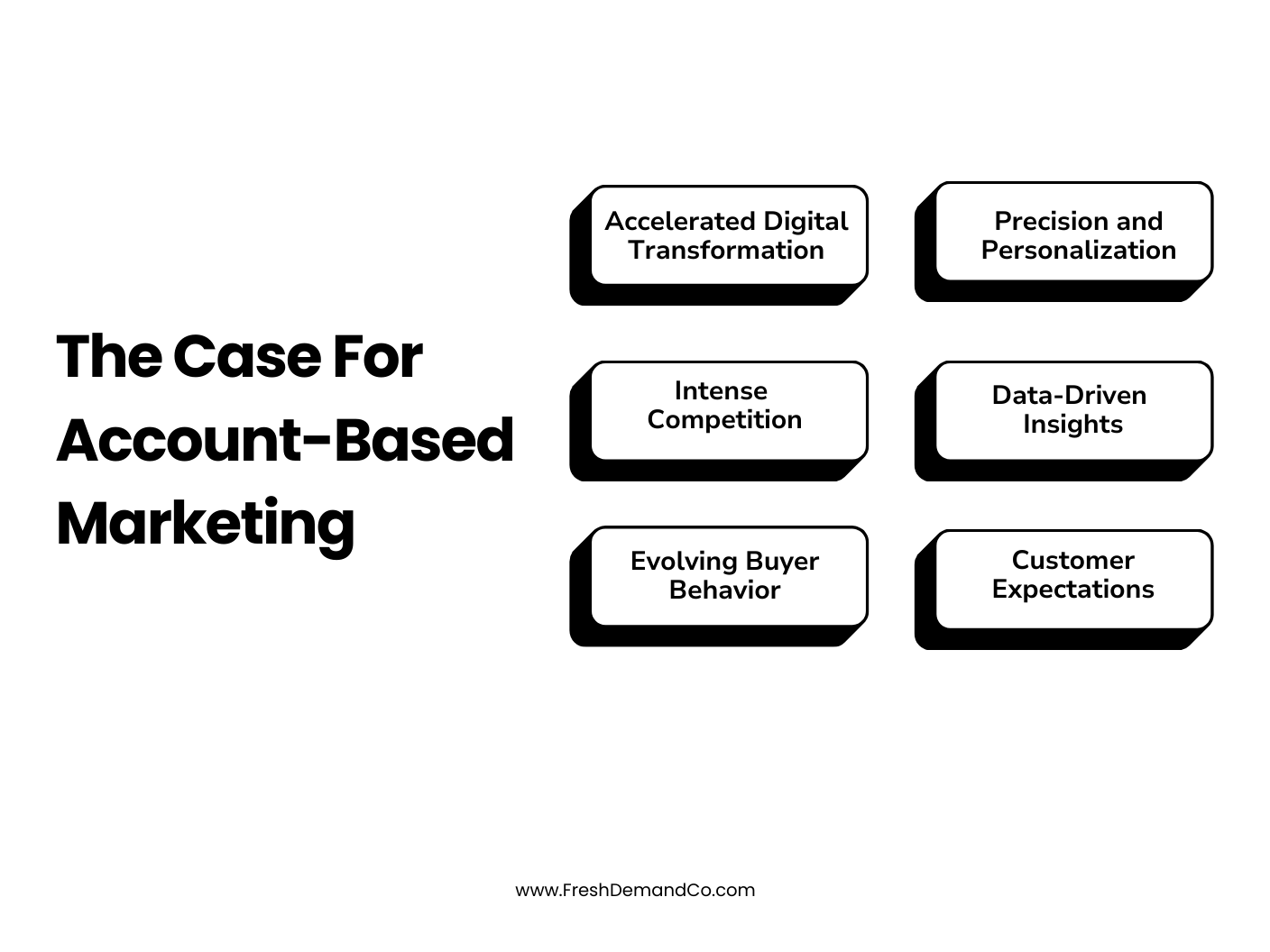

In a world where technological evolution meets shifting buyer expectations, the importance of account-based marketing stands out. Here are the top reasons you should be focused on implementing an ABM strategy.
Accelerated Digital Transformation
The digital era demands businesses to be agile, especially as the landscape undergoes rapid shifts. Account-Based Marketing (ABM) ensures this agility, enabling companies to respond more to market changes. This approach acknowledges the importance of digital transformation and actively leverages it. By incorporating advanced analytics, automation, and artificial intelligence, companies can create highly personalized campaigns tailored for specific high-value accounts.
Intense Competition
In the saturated B2B SaaS marketplace, more than merely offering quality is needed. The unique value proposition has become a game-changer, and this is where ABM shines. Through a deep understanding of individual accounts, businesses can customize their offerings, ensuring they resonate more effectively with potential clients. Additionally, by narrowing the focus on particular accounts, businesses are positioned to nurture more profound, more meaningful relationships—a crucial differentiator in today’s competitive environment.
Evolving Buyer Behavior
The modern buyer is both discerning and expects proactive engagement. ABM fosters a proactive approach, allowing companies to target potential clients with pinpoint accuracy based on real insights. This tailored approach ensures buyers are presented with a personalized journey, reflecting their unique needs and challenges, thus enhancing satisfaction and the likelihood of conversion.
ABM’s Precision
Marketing strategies are only as good as their execution, and precision is paramount. ABM offers this exactness, ensuring that resources are optimized for maximum impact. Instead of casting a wide net and hoping for the best, businesses can now focus on high-value accounts with a higher propensity to convert. This strategic allocation ensures better use of resources and leads to a significantly higher return on investment.
Data-Driven Insights
In an era where data is the new oil, ABM ensures that businesses extract maximum value. This strategy doesn’t merely react to data but uses predictive analytics to identify potential high-value accounts proactively. Furthermore, the insights gathered from ABM campaigns are invaluable, providing a feedback loop that allows for continuous refinement and evolution of marketing strategies, ensuring they remain relevant and practical.
Customer Expectations
The lines between B2B and B2C are blurred regarding customer experience. Modern B2B buyers expect transparency, relevance, and a personalized touch—essentially, a B2C-like experience. ABM caters to this expectation by ensuring consistency in messaging, branding, and engagement across all touchpoints. This meets the client’s expectations and fosters trust, laying the groundwork for a long-term and fruitful business relationship.
Harnessing the Power of Data for ABM and Targeting Prime Accounts in B2B SaaS
In today’s evolving B2B landscape, sales and marketing teams must merge precision with personalization. Nearly half of B2B buyers favor personalized marketing experiences. Achieving this requires a data-infused strategy that blends keen insights, adaptability, and collaboration.
Gartner‘s research underscores the impact of this alignment, revealing that companies with synchronized sales and marketing strategies are three times more likely to outpace their customer acquisition goals. However, 19% have achieved this alignment, emphasizing the gap between ambition and action.
Enter Account-Based Marketing (ABM)—a touchstone for contemporary sales and marketing endeavors.
Here’s a breakdown of essential steps to maximize data’s role in ABM.
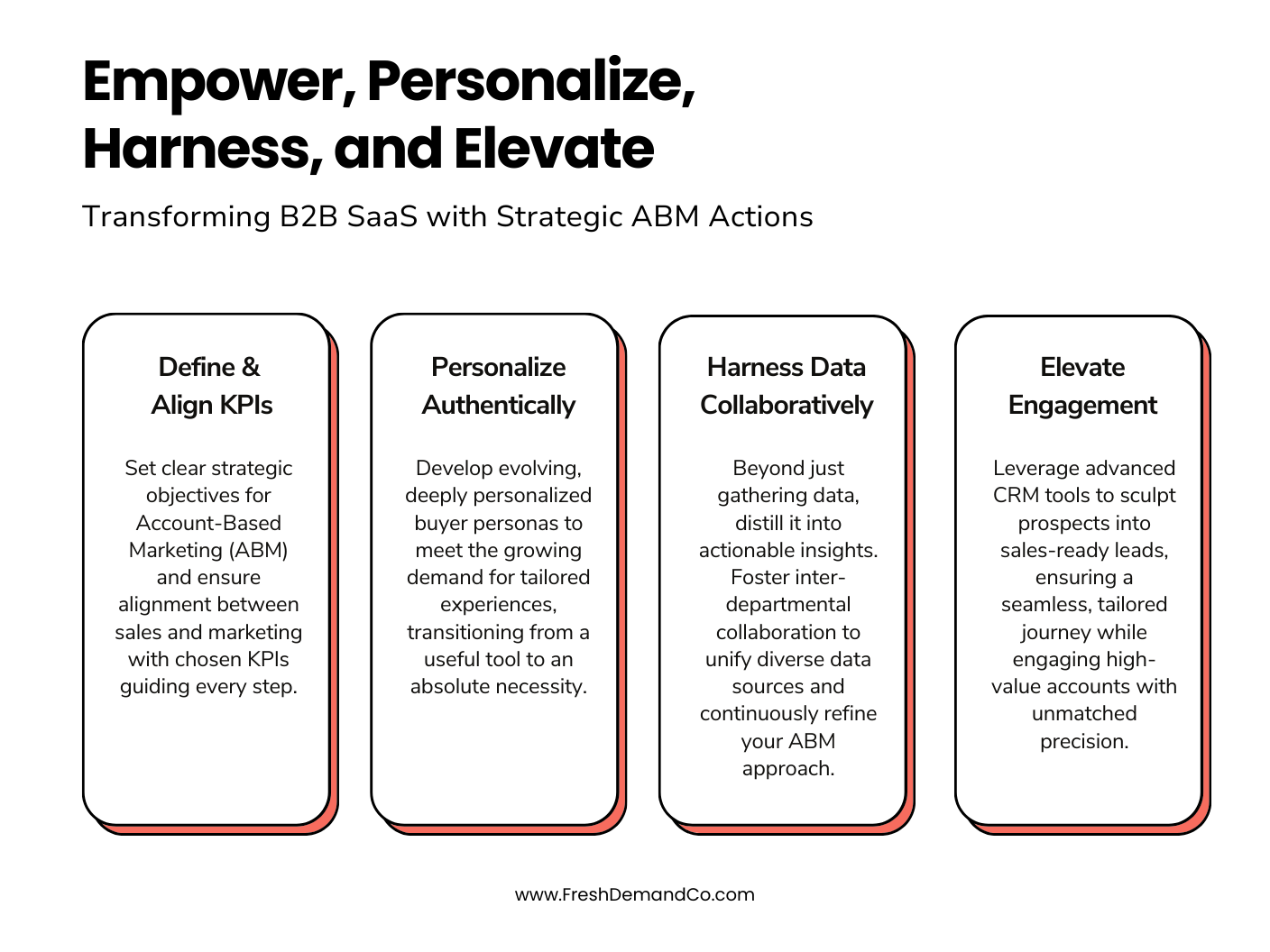
The success of ABM hinges on defining strategic objectives. Beyond just setting benchmarks, it’s pivotal to select Key Performance Indicators (KPIs) that act as lighthouses, guiding the ABM course and ensuring synchrony between sales and marketing throughout the customer journey.
Hyper-Personalization Through Persona Development
Modern ABM revolves around fluid, deeply personalized buyer personas. These are not stagnant outlines; they’re evolving blueprints guiding sales teams to connect authentically. With B2B buyers increasingly demanding tailored experiences, these personas transition from important to indispensable.
Data Identification and Actionable Insights
Upon understanding personas and objectives, it’s time to pinpoint the requisite data to supercharge ABM strategies. This phase goes beyond mere data collection—it’s about distilling that data into actionable roadmaps.
Collaborative Data Gathering
True ABM excellence emanates from collaboration. The ABM strategy becomes more holistic and impactful by unifying diverse data sources, from industry-specific databases to on-site KPIs, and enhancing team collaborations.
Sales-Marketing Synergy
Sales and marketing alignment is a strategic imperative. Continuous inter-team dialogue refines ABM approaches, adapting to target accounts’ fluid behaviors and preferences.
Elevating Customer Relationship Management (CRM)
Today’s B2B success is rooted in CRM. Demand generation teams use detailed personas while sales teams, armed with tools like Salesforce, sculpt these prospects into sales-ready leads, ensuring a journey that’s both seamless and tailored.
Embracing modern ABM is not just about adapting to the digital shift but mastering it. This dynamic approach positions sales and marketing teams to engage high-value accounts with unmatched precision, optimizing the B2B SaaS ecosystem.
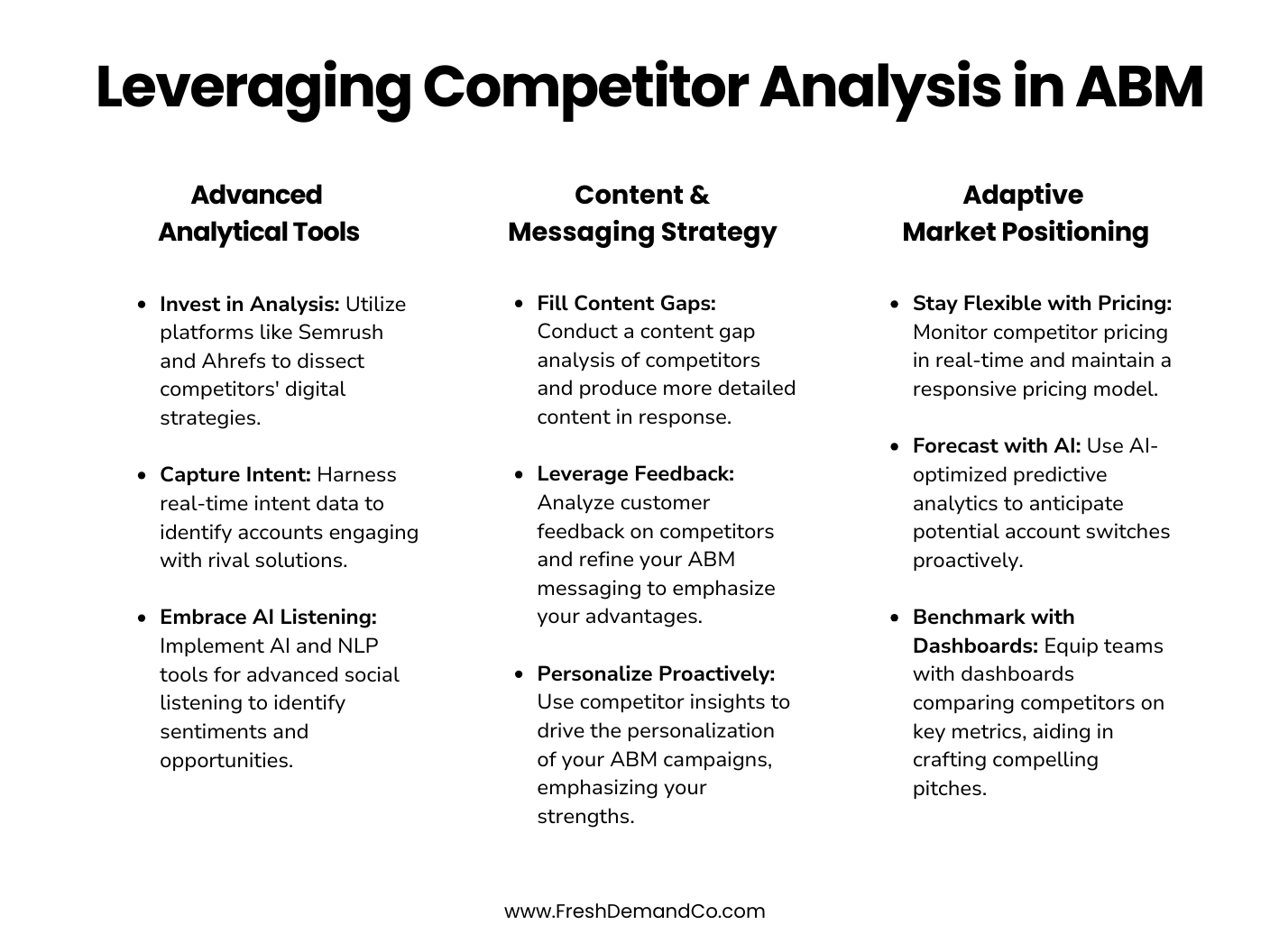
Understanding competitors is about monitoring their moves and proactively strategizing your position. Here’s how to powerfully integrate competitor analysis into your ABM campaigns:
Advanced Competitive Analysis Platforms
Invest in platforms tailored for SaaS like SEMrush, Ahrefs, or SimilarWeb. Beyond mere tracking, use them to dissect competitors’ digital footprints, from social campaigns to content strategies.
Harness Intent Data
Intent data becomes vital in SaaS, where product cycles are short and buyer intent is transient. Capture real-time insights on accounts engaging with competitor solutions and pivot your strategies to cater to their emerging needs.
Gap Analysis for Content
Conduct a content gap analysis by thoroughly examining your competitors’ content—following, spot areas they’ve overlooked or covered only superficially. Then, produce richer content that better addresses the intricate needs of informed SaaS buyers.
AI-Driven Social Listening
Modern challenges need modern solutions. Tools with AI and NLP capabilities track mentions and intelligently analyze sentiments, helping you tap into pain points or opportunities competitors might be missing.
Dynamic Pricing Intelligence
SaaS often operates in a volatile pricing market due to rapid innovations. Monitor competitor pricing shifts in real-time and maintain a flexible pricing model that can be swiftly adjusted to offer a competitive edge.
Analyze Customer Narratives
Regularly gather customer feedback to identify common challenges or complaints about competitors. Adapt your ABM messaging to emphasize how your SaaS solution directly resolves these concerns.
Predictive Analytics with an AI Edge
The SaaS sector’s agility demands a forward-looking approach. Use predictive analytics models optimized by AI to forecast which accounts might be contemplating a switch. Position your solutions preemptively.
Dashboard-Driven Insights
Equip your teams with intuitive dashboards that benchmark competitors on key metrics—like feature richness, uptime reliability, or customer support response. This real-time data aids teams in crafting persuasive pitches.
Dynamic Personalization in ABM
Let competitor insights inform the personalization engine of your ABM campaigns. For every pain point or shortfall in a competitor’s offering, emphasize your SaaS solution’s strengths and differentiators.
While the pace of innovation is relentless, competitor analysis within ABM is not just about keeping up—it’s about consistently staying a step ahead. By integrating these strategies, businesses can ensure they’re reactive and perpetually proactive in their market approach.
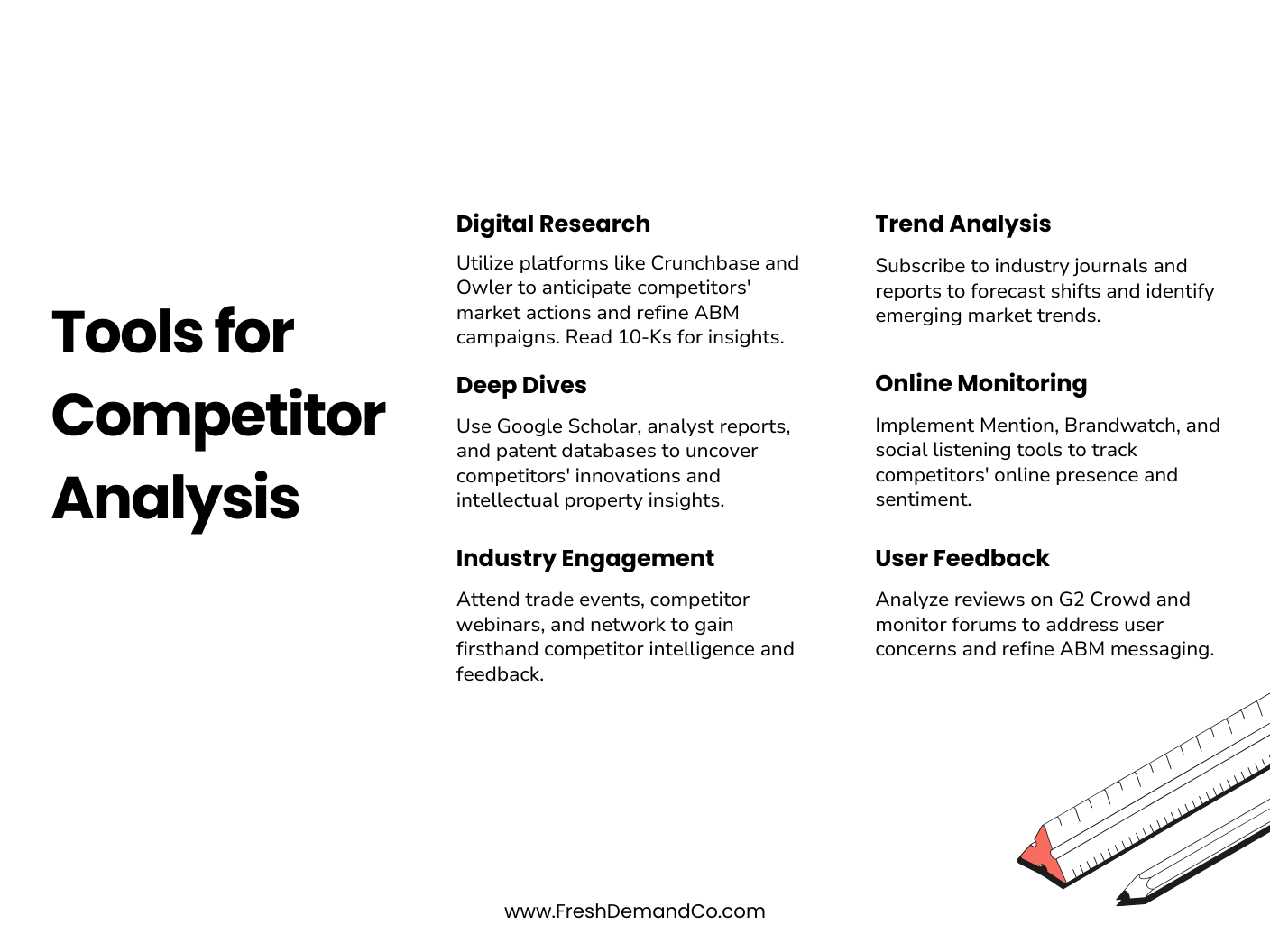
Although advanced tools have reshaped the B2B SaaS landscape, traditional methods retain their significance.
Here’s a blend of classical and contemporary tools pivotal for a thorough competitor analysis:
Competitor Analysis
Digital Platforms
Platforms such as Crunchbase, Owler, and CB Insights are treasure troves of business intelligence. They provide insights on competitors’ funding rounds, executive changes, mergers and acquisitions, and more. By understanding a competitor’s financial health and strategic moves, you can anticipate their market actions and adjust your ABM campaigns accordingly.
Search Engines
Specialized databases and search engines can offer much information beyond standard Google searches. Use tools like Google Scholar, industry-specific repositories, and patent databases to uncover competitors’ research efforts, innovations, and intellectual property.
Engage Actively with the Industry
Trade Events and Conferences are hubs for networking, learning, and gathering firsthand competitor intelligence. Attend competitor sessions, network with their customers and partners, and gather informal feedback to inform your ABM strategy.
Webinars: As virtual showcases become more popular, attending competitor webinars can offer a direct glimpse into their product updates, user engagement strategies, and customer pain points. Analyze the topics they focus on, the questions they address, and the features they highlight to refine your product positioning and messaging.
Industry Reports and Publications
Subscriptions: Subscribing to industry journals, analyst reports, and market research publications can keep you abreast of market trends, competitor rankings, and future predictions. Utilize these insights to identify market gaps, understand emerging trends, and forecast potential shifts in the competitive landscape.
Digital Monitoring
Monitoring Tools: Platforms like Mention, Brandwatch, and Google Alerts offer real-time tracking of brand mentions across the web, from news articles to blog posts. Set up alerts to inform your team of competitors’ product launches, partnerships, or PR crises.
Social Listening: Tools like Sprout Social, Hootsuite, and Brand24 allow you to monitor competitors’ social media activities and audience sentiments. By understanding their content strategies, engagement metrics, and audience feedback
User Insights
Review Platforms: Sites like G2 Crowd, Capterra, and TrustRadius provide user feedback and ratings on SaaS products. Analyze user reviews to identify competitors’ strengths and weaknesses, and utilize this feedback to fine-tune your product features and ABM messaging.
Forums and Discussion Groups: Communities like Stack Overflow, Reddit, and Quora often house candid discussions about product functionalities, bugs, and user wish lists. Participate in or monitor these discussions to gain grassroots-level insights and directly address potential customers’ concerns or queries.
By seamlessly integrating the insights derived from these foundational tools into your ABM strategy, you gain a competitive edge and ensure your marketing efforts resonate deeply with your target accounts in the B2B SaaS landscape.
Elevating Your Account-Based Marketing (ABM) Strategy
In the last few years, Account-Based Marketing (ABM) has evolved from a mere strategy to an absolute necessity in the competitive landscape of B2B SaaS. This section delves into advanced insights that can drive B2B SaaS firms toward unprecedented success. These crucial factors include target account prioritization, content customization, and highly personalized outreach, setting the stage for sustainable growth and market leadership.
Regarding the success of your Account-Based Marketing (ABM) strategy in the realm of B2B SaaS, the process of target account prioritization is a pivotal step. Here’s how to enhance your target account prioritization:

Gauge the technical readiness of your target accounts. Consider factors such as their existing technology stack, compatibility with your solutions, and their openness to adopting new technologies. Accounts that align closely with your technological offerings are more likely to convert into valuable clients.
Innovation Compatibility
Assess the willingness of your target accounts to embrace innovation. Explore their history of adopting new technologies or methodologies within their industry. Companies with a track record of embracing innovation are often more receptive to cutting-edge solutions.
Historical Responsiveness
Dive into the historical data regarding your target accounts’ responsiveness to marketing efforts. Analyze their engagement with past campaigns, response rates to emails, and interaction with your content. Marketing and sales should prioritize ideal accounts with an active interest in your offerings for more personalized outreach.
Alignment with Ideal Customer Profile (ICP)
Ensure your target accounts align with your Ideal Customer Profile (ICP). This profile should encompass basic demographics and behavioral and firmographic attributes. Accounts closely matching your ICP are more likely to convert and become long-term, high-value clients.
Scoring and Ranking
Develop a scoring and ranking system that considers all the above factors. Assign numerical values or scores to each criterion, allowing you to prioritize target accounts objectively. Accounts with higher scores should receive more focused attention and tailored ABM campaigns.
Dynamic Monitoring
Prioritization is not a static process. Continuously monitor and update your prioritization criteria as market dynamics change. Be prepared to shift your focus to emerging accounts with sudden interest or promising characteristics.
Recommendations for Effective Prioritization
-
- Data-driven decision-making: Utilize data analytics and business intelligence tools with your Customer Relationship Management (CRM) software to collect, organize, and analyze the data needed for effective prioritization. These tools can provide valuable insights into account behavior and engagement.
- Collaboration Between Sales and Marketing: Collaborate closely with your sales and marketing teams. Sales teams often have valuable insights into the readiness and responsiveness of target accounts gained through direct interactions.
- Regular Review Meetings: Schedule meetings to review and adjust your prioritization strategy. These meetings should involve sales, marketing, and leadership stakeholders to ensure alignment with business objectives.
- Pilot Testing: Consider piloting your prioritization strategy with a subset of target accounts before implementing it. A pilot test allows you to fine-tune your approach based on real-world results.
- Feedback Loops: Establish feedback loops with your sales teams to gather insights into the effectiveness of prioritization. Use their feedback to make necessary adjustments and refinements.
Adopting these recommendations and taking a comprehensive approach to target account prioritization will make your ABM strategy more refined, efficient, and successful. Focus on incorporating feedback loops to ensure your ABM leads are a good fit and more likely to convert and become valuable, long-term customers in the B2B SaaS landscape.

While personalized communication is critical, content customization plays a pivotal role in the success of your Account-Based Marketing (ABM) strategy. Going beyond generic messaging and embracing tailored content can significantly impact your engagement rates and conversion outcomes. Here’s how to excel in content customization and some actionable recommendations:
Understand the Buyer Journey
-
- Detailed Mapping: Begin by mapping out the distinct stages of the buyer journey for your target accounts. Understand their pain points, challenges, and decision-making processes at each stage.
- Persona Analysis: Create detailed buyer personas for each key decision-maker within the target accounts. Understand their goals, pain points, objections, and preferences to align your content accordingly.
Tailor Content Sequences
-
- Content Paths: Develop sequences or paths aligning with the buyer’s journey stages. Craft content pieces (e.g., articles, videos, infographics, case studies) that cater to prospects’ informational needs and concerns at each stage.
- Customized Messaging: Customize your messaging within each content piece to directly address the pain points and challenges specific to that stage. Demonstrate how your solution uniquely addresses these concerns.
- Educational Approach: Focus on educating and providing value rather than pushing for a sale. Your content should empower prospects with knowledge and insights that aid their decision-making.
Personalization Strategies
-
- Dynamic Personalization: Implement dynamic personalization within your content. Personalization can include using dynamic fields to insert the prospect’s name, company, or pain points into email subject lines and body content. Personalization can also extend to your website and advertising strategy.
- Behavior-Based Personalization: Leverage behavioral data to customize content recommendations. For example, recommend related content if a prospect has shown interest in a particular product feature.
- Recommendation Engines: Explore AI-driven recommendation engines that suggest relevant content based on a prospect’s interactions and interests. Tools like these can enhance content engagement.
A/B Testing and Iteration
-
- Continuous Testing: Conduct A/B testing on different content variations to determine what resonates best with specific accounts or personas. Analyze metrics such as click-through rates, conversion rates, and time spent on content.
- Iterative Improvement: Use the insights gained from A/B testing to improve your content customization strategy iteratively. Fine-tune messaging, content types, and personalization techniques based on performance data.
Automation and CRM Integration
-
- Automation Tools: Invest in marketing automation platforms that facilitate content customization at scale. These tools can automate content delivery based on prospect behavior and preferences.
- CRM Integration: Integrate your CRM system with your marketing automation platform to ensure seamless data flow. Connect the dots between systems to enable real-time prospect insights and tailor content accordingly.
Content Analytics and Feedback
-
- Content Performance Tracking: Implement robust content analytics to monitor the performance of your customized content. Identify which content pieces are driving engagement and conversions.
- Sales Team Feedback: Maintain open communication channels with your sales team. Gather feedback on the effectiveness of customized content in their interactions with target accounts. Use this feedback to refine your approach.
Compliance and Data Privacy
-
- Data Privacy Compliance: Ensure your content customization efforts comply with data privacy regulations (e.g., GDPR, CCPA). Obtain explicit consent when collecting personal data for personalization.
Transparency
-
- Inform prospects about using their data for content personalization and provide opt-out options.
Adopting these strategies and recommendations for content customization in your ABM strategy can create a more engaging and personalized experience for your target accounts. This approach enhances engagement and builds trust and credibility, ultimately driving higher conversion rates and long-term customer relationships in the competitive B2B SaaS landscape.
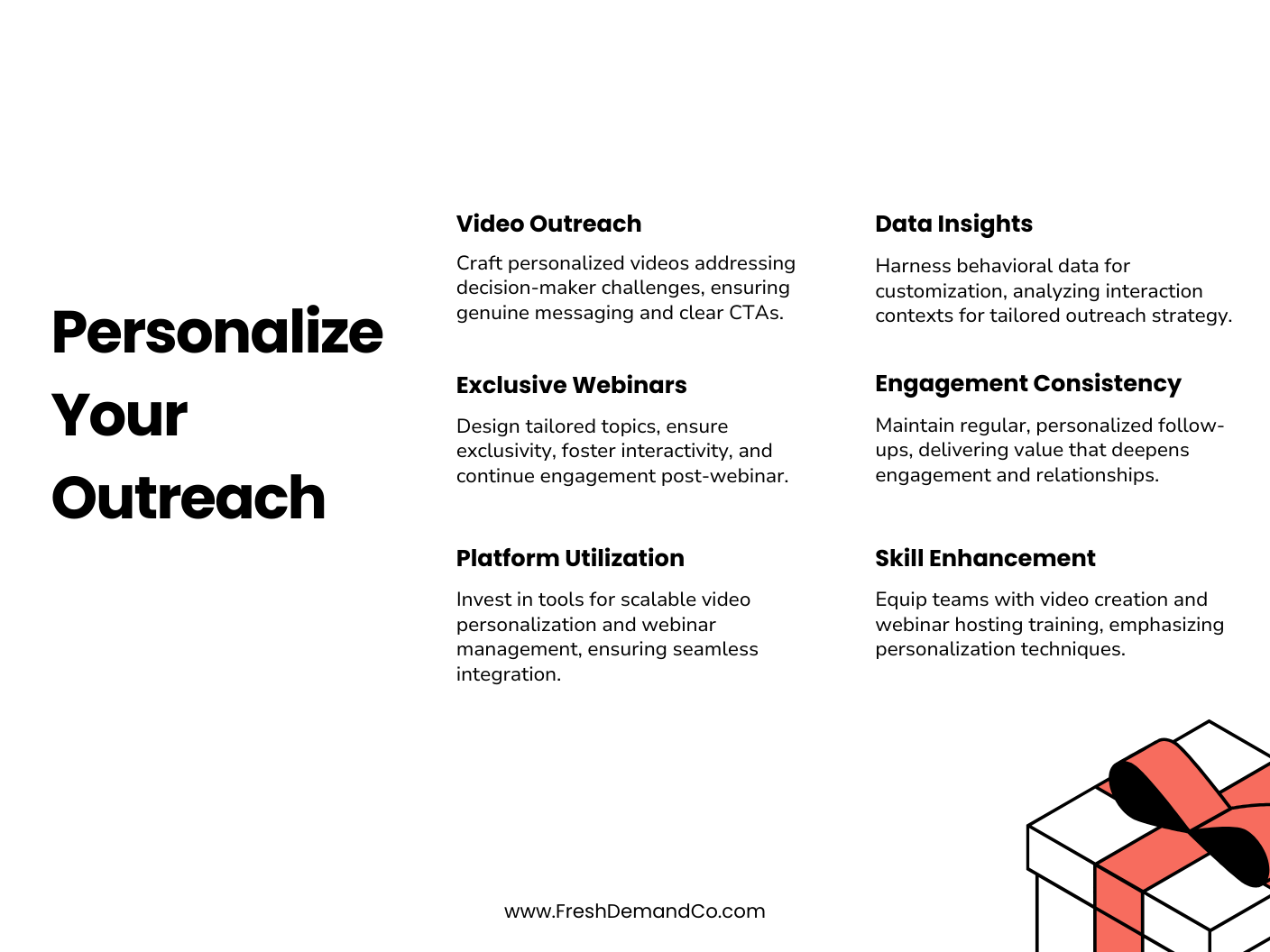
Going beyond conventional personalized emails, innovative outreach approaches like custom videos and exclusive webinars can set your efforts apart and significantly boost engagement and conversion rates. Here are actionable strategies and recommendations to excel in highly personalized outreach:
Custom Videos
-
- Tailored Messaging: Create personalized video messages addressing each key decision-maker’s unique pain points, challenges, and goals within the target accounts. Use their names and mention specific details relevant to their organization.
- Diverse Video Types: Experiment with various video types, such as introductory videos, product demos, personalized walkthroughs, or even video case studies showcasing how your solution can solve their specific problems.
- Human Touch: Personalized videos should convey a genuine human touch. Encourage the video sender to speak directly to the recipient, expressing a sincere interest in understanding and addressing their needs.
- Call-to-Action (CTA): Include a clear and personalized CTA in your video, guiding the recipient on their next steps. Your CTA might involve scheduling a call, requesting a demo, or downloading a resource.
Exclusive Webinars
-
- Tailored Topics: Design webinar topics that directly align with your target accounts’ interests and pain points. Ensure the content is highly relevant to their industry, challenges, and aspirations.
- Limited Attendees: Keep the webinar exclusive by limiting the number of attendees to key decision-makers within the target accounts. This exclusivity reinforces the personalized nature of the event.
- Interactivity: Foster interaction during the webinar by allowing attendees to ask questions, participate in polls, and engage in discussions. Interaction makes the event more engaging and personalized to their interests.
- Post-Webinar Engagement: Don’t end the personalized experience with the webinar. Follow up with personalized emails, content recommendations, or offers that align with the topics discussed during the event.
Personalization Platforms
-
- Video Personalization Tools: Invest in video personalization platforms that enable scale customization of video content. These platforms often integrate with marketing automation systems for seamless delivery.
- Webinar Hosting Platforms: Choose webinar hosting platforms that offer features for managing exclusive events, participant engagement, and post-webinar communication.
Personalization Data and Insights
-
- Behavioral Tracking: Leverage behavioral tracking data to understand target accounts’ specific interests and engagement patterns. Use this data to personalize video content and webinar topics.
- Contextual Interaction Analysis: Dive deep into the context of how target accounts interact with your platform or content by discerning not just what they engage with but also why and when. Context helps you craft personalized outreach emails, offering solutions tailored to their unique pain points or aspirations.
Consistency and Follow-Up
-
- Consistent Outreach: Maintain a consistent schedule of personalized outreach. Send follow-up emails, additional personalized videos, or exclusive content to keep the engagement alive.
- Personalized Follow-Up: When following up after a customized video or webinar, reference the content or insights shared during the previous interaction. Personal follow-up demonstrates a genuine commitment to addressing their needs.
Training and Skills Development
-
- Video Creation Training: Provide training and resources to your team or creators on effective video creation and personalized messaging techniques.
- Webinar Hosting Skills: Ensure your team is well-versed in hosting engaging and interactive webinars. Webinars may require additional training in presentation skills and webinar platform features.
You can establish a deeper connection with your target accounts by implementing these strategies and recommendations for highly personalized outreach within your ABM strategy. This customized approach demonstrates a profound commitment to addressing their unique needs and sets the stage for meaningful engagements and successful conversions in the competitive B2B SaaS landscape.
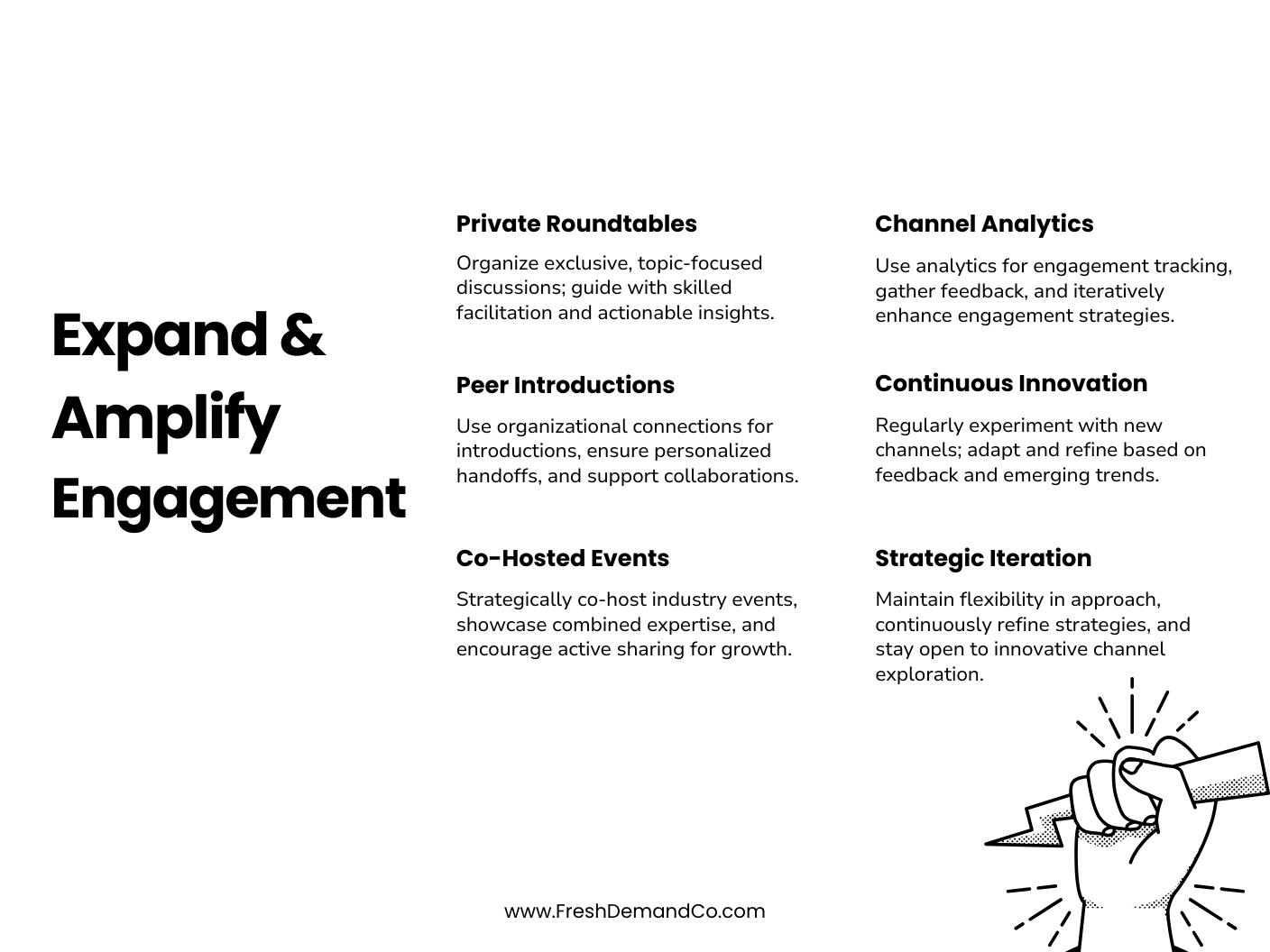
In Account-Based Marketing (ABM) for B2B SaaS, diversifying your engagement channels beyond the traditional trade shows and industry events can be a game-changer. Exploring alternative avenues like private roundtables, peer-to-peer introductions, or co-hosting industry-specific events with your target accounts can set your ABM efforts apart and strengthen your connections.
Here are actionable strategies and recommendations to excel in diversified engagement channels:
Private Roundtables
-
- Tailored Topics: Organize private roundtable discussions on topics directly relevant to the interests and challenges of your target accounts. Ensure that the discussion themes align with their industry trends and pain points.
- Selective Participation: Keep the roundtables exclusive, inviting key decision-makers and stakeholders from your target accounts. Limiting the number of participants enhances intimacy and engagement.
- Facilitated Discussions: Appoint a skilled facilitator who can guide the discussions effectively, ensuring that participants actively engage, share insights, and collaborate on potential solutions.
- Actionable Takeaways: At the end of each roundtable, summarize essential takeaways and action items. Share these with participants to demonstrate the tangible value of their involvement.
Peer-to-Peer Introductions
-
- Account Mapping: Identify individuals within your organization with solid connections or relationships with key decision-makers at your target accounts. These connectors can facilitate introductions.
- Personalized Introductions: Encourage your connectors to craft personalized introduction emails or messages. Highlight the mutual benefits of the connection and emphasize shared objectives.
- Warm Handoffs: Ensure that introductions lead to meaningful interactions. Facilitate warm handoffs, where the connector personally introduces the parties and outlines the context for collaboration.
- Follow-up and Support: After the introduction, provide ongoing support to both parties, ensuring the collaboration progresses smoothly. Offer resources, guidance, and assistance as needed.
Co-Hosted Industry Events
-
- Strategic Planning: Collaborate with your target accounts to identify industry-specific events, webinars, or workshops that align with their goals and interests. Plan the co-hosting arrangement strategically.
- Shared Content: Develop content and presentations showcasing your organization’s combined expertise and target accounts. Co-hosted content demonstrates a united front and positions you as industry thought leaders.
- Promotion and Outreach: Coordinate efforts to promote the co-hosted event to a broader audience. Leverage both organizations’ networks and channels for maximum reach and engagement.
- Engagement During the Event: Ensure active participation from both parties. Encourage discussions, Q&A sessions, and networking opportunities that involve representatives from both organizations.
Engagement Channel Analytics
-
- Tracking and Measurement: Implement analytics tools to track the effectiveness of your diversified engagement channels. Monitor attendance, participation, and outcomes of private roundtables, introductions, and co-hosted events.
- Feedback Collection: Gather feedback from your team and target accounts after each engagement. Make improvements based on what worked well in the past and use these insights for future initiatives.
Continuous Innovation
-
- Experimentation: Feel free to experiment with new engagement channels and approaches. Stay attuned to emerging trends and technologies that can enhance your ABM strategy.
- Iterative Approach: Continuously refine your diversified engagement channels based on the feedback and results. Flexibility and adaptability are crucial to success.
Diversified engagement channels set you apart in the competitive landscape and strengthen the bonds that lead to lasting business relationships in the dynamic world of B2B SaaS.
By creating a structured and advanced approach, B2B SaaS firms can revolutionize their decision-making processes, elevate their marketing endeavors, and optimize their sales outcomes. Adopting advanced ABM techniques represents a strategic and transformative leap toward sustainable growth and industry leadership. Prioritizing target accounts based on comprehensive criteria, tailoring content for precision, and deploying highly personalized outreach initiatives establish a solid foundation for navigating the complexities of the market. This structured methodology empowers firms with confidence and informed decision-making, ensuring enduring success in the dynamic landscape of B2B SaaS.