

How to Overcome MarTech Challenges to Maximize Growth
Over the last decade, the CMO’s role has evolved from a primary brand custodian to a growth architect. This shift demands B2B marketing teams to master marketing tech and align closely with revenue and sales teams. At the same time, advanced analytics and intelligence tools have reshaped how CMOs enhance the buyer journey and improve ROI. Below, we explore the interplay of technology use, the importance of sales-marketing alignment, and strategies for achieving B2B success.
Key Takeaways
- CMOs who focus solely on brand awareness are destined to fail. Set your team up to drive revenue-based marketing outcomes.
- Build your MarTech stack to make better end-to-end strategic decisions between sales and marketing. Your tools should support both enhanced buyer experiences and seamless sales growth.
- Proving ROI and connecting sales pipelines to marketing activities is easier said than done. Invest in the tools and talent to close the chasm between marketing and sales.
- Modern CMOs must holistically align with C-level counterparts and cross-functional teams to meet ambitious growth targets. Without this alignment, the best strategies will fail to reach their full potential.
 Adapting to Evolving Martech
From marketing automation to predictive revenue generation, the CMO must navigate ever-evolving challenges and tools. As tools like Pardot, Hubspot, 6Sense, Demandbase, LinkedIn, and Google Analytics evolve, CMOs encounter pivotal decisions and challenges.
We’ll look closer at the top challenges B2B CMOs and their teams face and suggest how to overcome them. Let’s first start with:
- Proving ROI on marketing spend
- Understanding the impact of marketing channels and campaigns
- Improving ROI through the best technology mix
 Proving ROI on Marketing Spend
Marketing invests significant time and money in creating strategic and memorable experiences across the buyer’s journey. With more aggressive sales growth targets comes more scrutiny and validation required for every line item in the marketing budget.
The Sales-Marketing Relationship Conundrum
The average cost per lead (CPL) for B2B SaaS companies is $237. You face the dual challenge of optimizing marketing spend while driving quality leads through the sales funnel. Despite advancing MarTech tools and tighter sales alignment, many CMOs grapple with accurate ROI tracking and reporting. Less than 25% of marketers are reporting how campaigns are impacting revenue. Increasing CPL and lackluster campaigns are a symptom of underlying tension between marketing and sales teams. This is especially difficult when there’s ambiguity in ownership and accountability for growth metrics. To navigate these challenges, establish clear communication channels, set joint KPIs, and leverage data-driven insights. Sales and marketing need shared goals, vision, and roadmap for growth. Regular strategy sessions and cross-departmental reviews can help bridge this gap.
Leading CMOs approach ROI as a measure of past performance and a predictive guide for future investment. They leverage advanced analytics and AI-driven forecasting to allocate marketing spend. These CMOs champion the integration of financial modeling into marketing strategies, ensuring that every dollar spent is an investment in the company’s scalable growth rather than a mere cost.
Pillars of Data-Driven Decision Making
Marketing teams often struggle to pick the right KPIs. They may not align KPIs with goals and strategy. Or they lack tools for effective measurement. Any misstep here is like driving with a flat tire. It’s doable but harmful in the long run. Both quantitative and qualitative metrics are crucial. They ensure ROI from marketing campaigns and channels. They also gauge intangible outcomes, like client satisfaction.
Mastering Marketing Metrics
Establishing ROI begins with a deep dive into advertising efforts, campaign effectiveness, and channel performance. Key metrics like conversions and velocity (speed) of leads moving through the sales funnel are crucial. As such, teams need detailed reporting (engagement through conversion) to fine-tune marketing and sales motions.
If your leads are not converting, it’s an indication that you need to reassess your marketing and sales campaigns. This could be due to several factors, such as the messaging, creative elements, or the channels used. Ensuring consistency between sales and marketing, from automated nurture campaigns to targeted sales enablement, is critical. For B2B SaaS companies, where buyer teams are growing, and market dynamics can change rapidly, aligning to buyers’ needs can be the real driver of success.
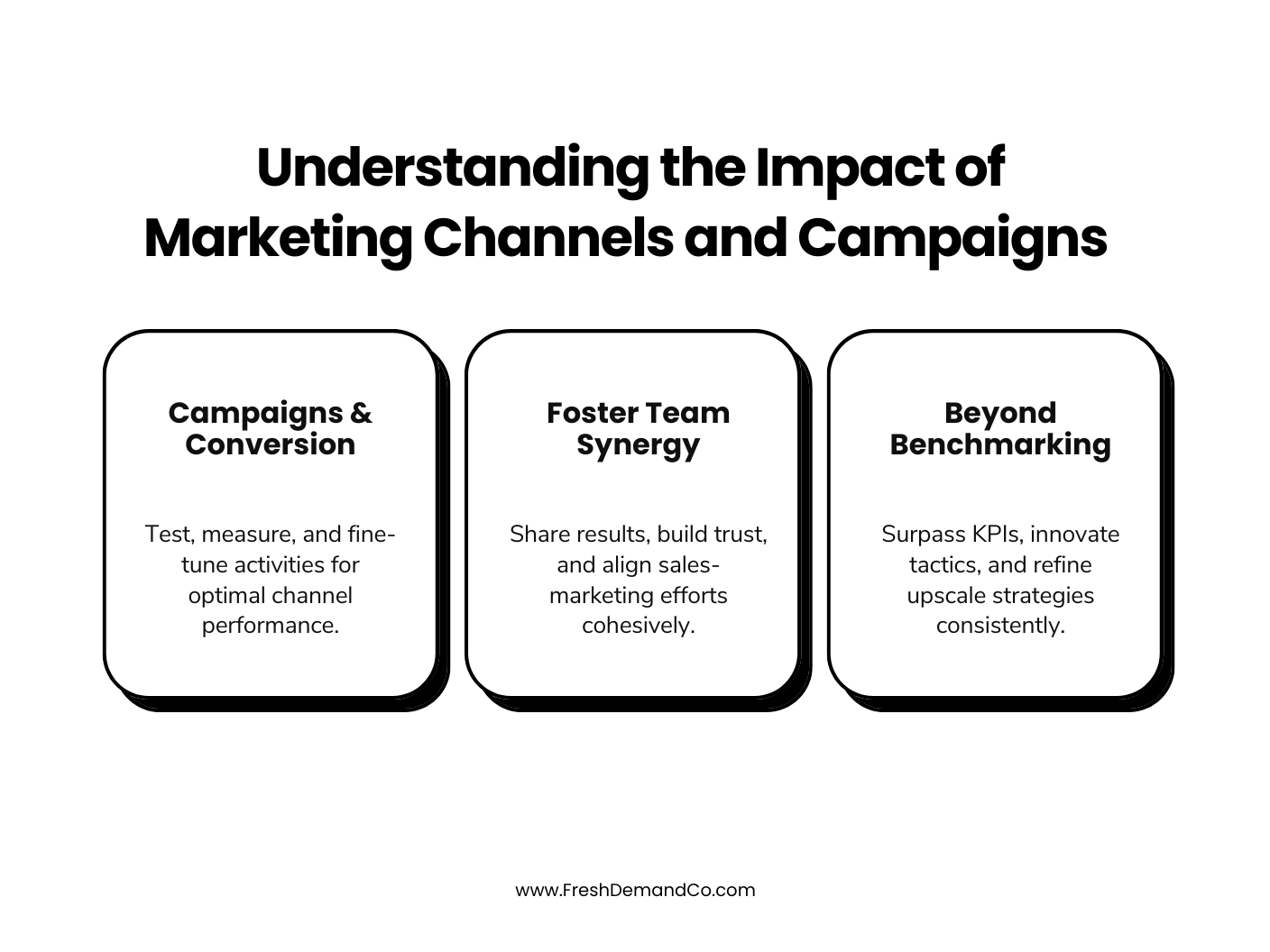 Understanding the Impact of Marketing Channels and Campaigns
A significant hurdle in demonstrating ROI lies in linking marketing efforts directly to movements in the sales pipeline. To navigate this challenge, modern marketing teams meticulously analyze previous campaigns’ outcomes to forecast future initiatives’ success accurately. Continuous experimentation, evaluation, and refinement of strategies are essential across demand creation, pipeline development, brand enhancement, and product promotion.
Channel Optimization and Fine-tuning Your B2B Marketing Strategy
Fluctuations in conversion rates by channel can impact marketing ROI. Without an established test, learn, and optimize the process, you’ll invest more in channels or activities that drive lackluster results. Instead, marketers must consider the buyer’s journey and the role of each channel in driving awareness, interest, and consideration, as well as conversion at each stage in the sales lifecycle. Connecting marketing efforts to your sales funnel and opportunity pipeline are table stakes.
For instance, if your PPC and LinkedIn campaigns are designed to attract new leads, evaluating their performance beyond initial engagement is essential. A high lead generation rate from PPC might be overshadowed by a high dropout rate during the nurturing phase, signaling a need for message or medium adjustment.
In such cases, it’s vital to assess the funnel metrics of this channel, like revenue and sales velocity, before adjusting your campaign. Tweaking target accounts, refining data for precise targeting, and tailoring ad copy and audience parameters by industry or function can enhance performance.
Choose one activity to test before moving on to another for campaign and channel optimization. You can also take a broader look at the impact of Marketing Qualified Leads (MQL) on sales and develop a new strategy to pilot test. Identifying which channel is driving the most Sales Qualified Leads (SQLs) is expected by revenue-focused teams.
For top-performing CMOs, understanding the impact of marketing channels and campaigns goes beyond surface-level metrics. They employ sophisticated attribution models that account for the complex interplay between multiple touchpoints and their collective impact on the buyer’s journey. By leveraging machine learning and AI, these CMOs gain deep insights into customer behavior and preferences, allowing for hyper-personalized campaigns that significantly improve engagement and conversion rates.
Demand Generation Performance
First, ensure your demand generation activities are mapped to the buyer’s journey. This will allow you to utilize your tech stack better to measure marketing strategies effectively and guide Marketing Qualified Leads (MQLs) through conversion, maintaining a cost-efficient lead generation process. Improving pipeline growth and velocity becomes challenging for sales and revenue teams without a view of the entire demand generation and lead nurturing process.
Continuous monitoring and analysis of demand generation performance are essential. Regularly sharing insights and outcomes with the sales and operations teams fosters a unified approach to achieving business objectives. Celebrating successes, such as a notable increase in sales conversions resulting from targeted lead strategies, reinforces the value of marketing efforts and strengthens the collaboration between departments.
The complexity of demonstrating ROI underscores the necessity for precise, measurable marketing campaigns. Simplifying reporting processes and focusing on actionable data can minimize errors and provide a clearer picture of marketing’s impact on revenue. By maintaining a streamlined approach to demand generation, sales, and marketing can align to optimize their efforts and overall growth strategy.
Benchmarking and Continuous Evolution
Regularly comparing your performance metrics against industry benchmarks is the next step. For industry-leading companies, the expectation is that investments in marketing yield substantial returns on investment (ROI), signifying efficient use of resources. This benchmarking serves as a measure of current success and a foundation for ongoing innovation and improvement.
As your company secures a larger market share and outperforms critical performance indicators (KPIs) relative to competitors, it’s an opportunity to refine and advance your marketing strategies. Consider deploying targeted efforts to engage high-value prospects through memorable experiential marketing campaigns or utilizing precise ad targeting to reach specific segments more effectively. Moreover, continuously optimizing your strategies for upselling and cross-selling can enhance customer value and contribute to sustained business growth. This approach of continuous evolution, driven by data and industry benchmarks, ensures that your marketing efforts remain on the cutting edge.
 Improving ROI Using the Best Technology Stack
Chief Marketing Officers (CMOs) oversee a company’s marketing efforts and ensure that they contribute directly to the company’s bottom line. To improve ROI, it is critical to integrate account-based marketing (ABM) platforms and marketing automation solutions with CRM systems. This integration provides a clear view of the pipeline, enables seamless revenue attribution, and turns data into actionable insights for optimized marketing efforts, resulting in increased revenue.
However, adopting sophisticated ABM strategies and AI-driven tools is just the beginning. The true measure of success lies in managing leads effectively and ensuring a smooth transition between marketing and sales. This is where the synergy between marketing automation software and sales automation tools comes into play. Platforms like HubSpot and Salesloft, integrated with CRMs such as Salesforce Sales Cloud, facilitate a unified approach. Prospects can be precisely segmented based on engagement levels, aligning marketing and sales efforts throughout the buyer’s journey.
Innovation-driven CMOs view their technology stack as a constantly evolving ecosystem that needs to adapt to changing market dynamics and customer expectations. They prioritize flexibility and scalability in their MarTech choices, ensuring seamless integration between tools and platforms to create a unified marketing operation.
Integrating Automation and Sales Efforts
Divide your prospects and leads into segments based on their interactions to improve your marketing and sales process. This will help you determine where they are in the buyer’s journey and what kind of automated outreach they need from the marketing or sales team. You can also use advanced features like account-based intent data and predictive lead scoring to personalize and optimize the outreach process in real time.
To enhance the efficiency of your lead generation strategies, it’s essential to include automation triggers. These triggers notify both marketing and sales teams about leads that are highly valuable and ready for sales. This helps to improve accountability across the entire demand generation process. Additionally, real-time dashboards and reports can help better understand how leads move through the funnel, thus helping identify potential marketing and sales pipeline bottlenecks.
Collaboration is essential if your company follows an Account-Based Marketing (ABM) approach. It’s not just about the internal teams; it also involves partners, key account decision-makers, and influential B2B figures. This collaborative effort can be effectively supported by technology that automates marketing attribution, ensuring that every touchpoint is accounted for. This eliminates the need for manual attribution methods and enhances the accuracy of ROI measurement.
 The Holistic Approach for CMOs
The evolving expectation for CMOs to deliver on aggressive growth goals is only realistic if they align holistically with their C-level peers and cross-functional teams. Doing so will be challenging but rewarding as data-driven insights from marketing spending, ROI tracking, campaign, and channel strategy, and the effectiveness of MarTec tools propel B2B companies to achieve significant revenue growth.
Embracing the Growth-Centric B2B Marketing Strategy
It’s more possible now than ever to prove ROI, as long as marketing and sales teams understand and track their tactical performance, have a process for optimization throughout the buyer’s journey and sales lifecycle, and are working in service of continuous improvement and evolution. With access to sophisticated MarTech tools, tracking, and close alignment with sales and revenue operations, CMOs can assume their rightful role as company-wide growth and digital transformation heroes.
FAQs
How do CMOs prioritize investments in new MarTech tools?
Marketing executives should prioritize investing in Marketing Technology (MarTech) based on the specific needs of their marketing and sales teams, the potential return on investment (ROI), and alignment with overall business goals. It is essential to conduct thorough research, including demos and consultations with vendors, and consider starting with pilot programs to assess effectiveness before fully committing. Beyond initial assessments and pilot programs, CMOs should consider the MarTech tools’ scalability and adaptability to future marketing needs and technologies. Evaluating the vendor’s roadmap for product development and support services is crucial. Also, it is essential to understand the tool’s community and ecosystem to gain insights into its longevity and integration capabilities.
What are the best practices for integrating MarTech tools with existing systems?
Best practices include ensuring data compatibility, conducting a thorough needs assessment to identify gaps that new tools should fill, and involving IT and data security teams from the beginning to address integration challenges and compliance issues. A critical, often overlooked aspect of integration is the user adoption and training phase. Successful integration depends on technical compatibility and how well the marketing team understands and embraces the new tools. Tailored training programs and user support can facilitate smoother transitions and ensure investments in MarTech tools deliver their intended benefits.
How can CMOs measure and improve the customer experience throughout the buyer’s journey?
Implementing customer relationship management (CRM) systems, customer data platforms (CDPs), and analytics tools to track interactions across all touchpoints can help. Additionally, gathering customer feedback through surveys and monitoring social media can provide insights into areas for improvement. Beyond digital analytics and feedback mechanisms, employing qualitative research methods such as user interviews and observation studies can offer deeper insights into the customer experience. These approaches help understand the nuances of customer behavior and preferences that quantitative data might not fully capture.
What strategies can foster better alignment between marketing and sales teams?
Regular joint meetings to discuss goals, progress, and challenges; shared KPIs and metrics; a unified approach to the customer journey; and collaborative tools and platforms can enhance alignment. Creating a culture of mutual respect and understanding is also crucial. Technology can play a pivotal role in fostering alignment, with shared dashboards and communication platforms enhancing transparency. However, aligning incentives and rewards to encourage collaborative efforts towards common goals is equally important. Such alignment ensures that both teams are motivated to work together effectively.
How do CMOs stay ahead of the curve with rapidly evolving marketing technologies and trends?
Continuous learning, attending industry conferences, participating in webinars, engaging with peer networks, and experimenting with new tools and strategies can help CMOs stay informed and adaptable. While staying informed is crucial, CMOs must cultivate a culture of innovation within their teams. Encouraging experimentation and tolerating failures as part of learning can help organizations adapt rapidly to new technologies and trends. It’s about balancing the risk of trying new approaches with the potential competitive advantage they may offer.
What role does content marketing play in the B2B buyer’s journey, and how can it be optimized?
Content marketing is critical for educating and nurturing B2B buyers, building brand authority, and supporting the sales process. Optimization involves creating high-quality, relevant content targeted to different stages of the buyer’s journey, using SEO best practices, and promoting content across the proper channels. Leveraging analytics to understand content performance is critical, as is the iterative content creation process based on feedback and engagement metrics. Personalization of content to address the specific needs and pain points of different personas at various stages of the buyer’s journey can significantly enhance its effectiveness.
How can companies ensure data privacy and compliance using advanced analytics and MarTech tools?
Companies must be aware of and comply with relevant data protection regulations (such as GDPR and CCPA), conduct regular data audits, ensure vendor compliance, implement strict data access controls, and educate employees on data privacy best practices. With the increasing importance of data privacy, adopting a privacy-by-design approach in marketing strategies and MarTech implementations can provide a competitive advantage. This involves integrating data privacy into the system development process rather than treating it as an afterthought.
What are the emerging technologies CMOs should be aware of, and how can these impact B2B marketing strategies?
Emerging technologies such as artificial intelligence (AI), machine learning, augmented reality (AR), and blockchain can revolutionize B2B marketing through personalized experiences, improved analytics, enhanced customer engagement, and secure transactions. As these technologies evolve, CMOs should also consider the ethical implications and the potential for unintended consequences, such as biases in AI algorithms or privacy concerns with AR experiences. It’s crucial to balance innovation with responsibility and trust.
How can CMOs demonstrate marketing’s contribution to revenue growth to other executives and stakeholders?
By implementing comprehensive tracking and analytics to directly link marketing activities to sales outcomes, using attribution modeling, and regularly reporting on key metrics that illustrate marketing’s impact on the sales pipeline and revenue. Beyond quantitative metrics, qualitative insights, such as customer testimonials and case studies, can powerfully demonstrate the impact of marketing. These narratives can complement data-driven evidence to provide a more holistic view of marketing’s value to stakeholders.
What are the challenges and opportunities of adopting an Account-Based Marketing (ABM) strategy in B2B marketing?
Challenges include the need for precise targeting, alignment between marketing and sales, and measuring the impact of ABM efforts. Opportunities include higher ROI, personalized marketing efforts, and stronger relationships with key accounts. The digital transformation and the proliferation of data analytics tools have enabled more sophisticated ABM strategies, allowing for real-time adjustments and highly targeted campaigns. However, this also requires a continuous investment in data quality and integration capabilities to leverage ABM’s potential fully.